
In addition to today’s resource, please review In addition to today’s resource, please review the 46 page PDF, Cognitive Health Assessment Implementation Guide from UCSF Dementia Care Aware.
Today, I review, link to, and excerpt from The Curbsiders‘ #478 Dementia 2.0 with Anna Chodos.*
*Witt LJ, Heller, M, Chodos A, Williams PN, Watto MF. #478 Dementia 2.0”. The Curbsiders Internal Medicine Podcast. thecurbsiders.com/category/curbsiders-podcast April 7, 2025.
All that follows is from the above resource.
Transcript available via YouTube
Updates in classification, evaluation, and treatment
Become dexterous with dementia management! We’re talking with Dr. Anna Chodos about cognitive domains, diagnostic criteria, patient and caregiver resources, new antibody therapies, and brain health plans!
Claim CME for this episode at curbsiders.vcuhealth.org!
Patreon | Episodes | Subscribe | Spotify | YouTube | Newsletter | Contact | Swag! | CME
Show Segments
- Intro
- Rapid fire questions
- The Terminology of Neurocognitive Disorders
- Cognitive Domains: A Comprehensive Approach
- Physical Examination Insights
- Medical Workup for Dementia
- Imaging and Biomarkers in Dementia Diagnosis
- Referral Considerations for Dementia Patients
- Understanding Dementia Stages and Prognosis
- Implementing Brain Health Plans
- Medications for Dementia Management
- Controversies in Monoclonal Antibody Therapies
- The Importance of Early Detection and Planning
- Outro
Disclosures
Dr. Chodos received remuneration from Novo Nordisk for participating in a task force looking at the feasibility of incorporating biomarkers for Alzheimer’s disease into primary care. The financial relationship has ended. The Curbsiders report no relevant financial disclosures.
The production of this episode was supported by the Penn Geriatrics AGE-SMART Geriatric Workforce Enhancement Grant. This podcast content is solely the responsibility of the authors and does not necessarily represent the official views of the Health Resources and Services Administration or the U.S. Department of Health and Human Services.
Dementia 2.0 Pearls
- Mild neurocognitive disorder is defined as cognitive changes from baseline in the absence of functional impairment. Major neurocognitive disorder is cognitive impairment causing functional impairment.
- There are six cognitive domains outlined in the DSM-V diagnostic manual for neurocognitive disorders: memory and learning, language, executive functioning, perceptual/motor, social cognition, and complex attention.
- Initial diagnostics include testing for reversible causes and, typically, head imaging. MRI is preferred for better structural information.
- Early detection of dementia is important so that patients and families can plan for the future. It also helps the patient better engage in their care while their disease is still mild.
- A “brain health plan” is a cornerstone of dementia prevention and intervention. This includes recommendations for physical and social activity, management of cardiovascular risk factors, treatment of hearing/vision impairment, and careful medication review/deprescribing when necessary.
- The traditional oral/transdermal medication categories for dementia are anticholinesterase inhibitors and NMDA antagonists, which can have some limited symptomatic benefits but may not have clinical benefit and could come with adverse effects.
- Newer disease-modifying monoclonal antibody therapies may be offered to patients with early stage Alzheimer’s disease pathology. For eligibility, they require extensive workup, frequent infusions and periodic head imaging to check for ARIA (cerebral hemorrhage or edema) as a side effect. Eligible/interested patients should be referred to neurologists for evaluation.
Diving into Dementia
Making the diagnosis
The terminology of neurocognitive disorders
The DSM 5 (published in 2013) classification for cognitive impairment is mild neurocognitive disorder (known commonly as mild cognitive impairment) and major neurocognitive disorder (often called dementia). Note: in this episode Dr. Chodos uses the term “minor neurocognitive disorder” instead of “mild neurocognitive disorder.”
What distinguishes the two is function (remember: geriatricians love assessing function)! In both, cognitive decline (from previous level in 1+ cognitive domains) is present and not due to medications, substances, or psychiatric conditions.
- Mild neurocognitive disorder (AKA mild cognitive impairment): cognitive symptoms ARE NOT affecting INDEPENDENT day to day function (see more on function below!). However, the individual may be exerting more effort to accomplish tasks or compensatory strategies (like using maps or calculators more often).
- Major neurocognitive disorder (AKA dementia): cognitive symptoms ARE “interfering with independence” in day to day functioning.
The six cognitive domains
- Memory and learning: this one gets all the attention and glory, because Alzheimer’s is most common and well-known (and defined early by memory loss). Ask: Are you/they having more trouble remembering conversations, appointments? Trouble recognizing family members?
- Language: Ask: Are you/they having word finding difficulty? Trouble understanding what people are saying or following conversations?
- Executive functioning: Ask: Are you/they having difficulty preparing a meal? Planning a trip? Managing finances?
- Social Cognition (behavior): Ask: Are you/they having changes in mood or personality? Any auditory or visual hallucinations?
- Perceptual-motor (visuospatial): Ask: Are you/they getting lost or driving in familiar places? Any falls? Are you/they having tremors, falls, trouble swallowing, constipation, or sleep issues?
- Complex attention (or just attention!). Ask: are you/they having trouble focusing on a task?
Function Function Function
Activities of Daily Living (ADLs) to ask about are bathing, dressing, transferring, toileting, grooming and feeding. Instrumental Activities of Daily Living to evaluate are using the telephone, preparing meals, managing household finances, taking medications, doing laundry/housework, shopping and managing transportation (UCSF, Dementia Care Aware). Remember that this should represent a change in their previous level of functioning (eg if someone never did the laundry, it isn’t a red flag that they aren’t currently doing the laundry!). Additionally, the barriers to function should be related to cognition, not physical function.
If possible, getting collateral information from an informant (like a relative, friend, caregiver, neighbor, etc) is very helpful. Think about the trajectory and severity of symptoms and don’t forget to ask about educational history and a history of an intellectual disability or psychiatric illness.
The MiniCog– an excellent screening tool
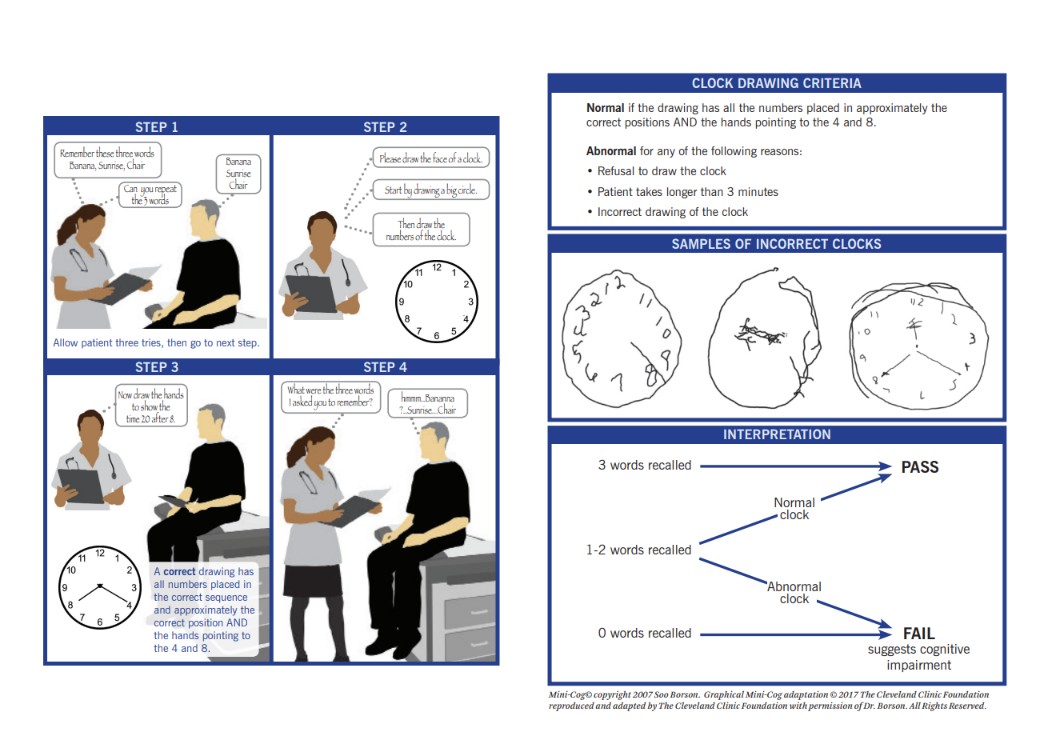
A reminder- the Mini-Cog is a three word recall followed by a clock draw (Borson et al 2000).* This test makes a great screening tool because it’s very doable in the clinic OR by telehealth (brief and just needs a pen and paper!). It can also translate into many languages and is accessible for patients with varying degrees of education. A positive test indicates a higher posttest probability of having dementia, so if your patient scores less than 3, proceed to next steps for evaluation.

*Instructions For Administration And Scoring The Mini-Cog.
Please review
Starting the workup
Don’t forget the physical exam in addition to your excellent history (Livingston G, et al 2024)! As expected, the neuro exam is one of the most important pieces of your targeted exam. Things to look for include signs of asymmetry (indicating possible prior strokes), Parkinson’s signs (can point to Lewy Body territory), and a gait assessment (Verghese 2022).
Next, check for reversible causes of cognitive impairment. When it comes to lab work, these include vitamin B12, TSH, HIV, and RPR. You can skip the HIV and RPR (or other syphilis testing) in the absence of risk factors.
Head imaging is also generally worth doing in every patient getting a workup for dementia to make sure you’re not missing anything (tumor, metastases, other structural abnormalities). This is especially important for patients with a history of head injury, HIV, on anticoagulation, younger in age, or with rapid onset of symptoms. MRI can be more useful for structural information (Živanović et al 2023), but a CT also works in absence of red flags or if an MRI is not available. On MRI, temporal lobe atrophy can be a sign of possible Alzheimer’s, or age-inappropriate volume loss. The more atrophy seen, the more severe disease is likely. Chronic small vessel disease is a common finding but can sometimes suggest a vascular etiology.
What about biomarkers? While we can make a clinical guess as to the cause of someone’s dementia, newer biomarker testing can look specifically for biomarkers of Alzheimer’s disease (Graff-Radford et al 2021). These include CSF studies looking for amyloid or tau proteins (low amyloid or high tau = suspicious for Alzheimer’s). Blood biomarkers are also available looking for amyloid proteins. There are also amyloid-specific PET scans. Insurance coverage is variable depending on the test and indication. Since these would be used to guide treatments typically in the neurologist’s domain, these tests should be ordered by specialists, as well.
Who should see a geriatrician, neurologist, or other dementia specialist?
In general, patients with milder disease are more appropriate for specialist care. Patients with more severe disease are unlikely to be able to complete intensive neuropsych testing. Also, patients with milder disease are more appropriate to be evaluated for monoclonal antibody therapies.
Neuropsychological testing is available online in your home.
The diagnosis is made– what next?
Let’s talk about it
For starters, it’s important to explain what dementia actually is! Often patients have preconceived notions of the diagnosis, so it’s important to give them the facts. Dementia is cognitive decline from baseline impacting function. You can tell them what the most likely etiology is based on their workup (Ex: “Based on MRI findings and your cognitive evaluation, it’s likely that this is due to Alzheimer’s disease”). You can also talk about staging. Remember:
- Mild: difficulty in IADLs but independent in ADLs
- Moderate: some assistance with ADLs
- Severe: dependent in ADLs
It’s important to discuss prognosis earlier in a patient’s diagnosis while they are still more independent and engaged in care. This is an important time to start planning for the future and symptoms to expect going forward.
Safety first
For patients with more severe disease at time of diagnosis, highlight strategies for keeping the patient safe at home. You may be required to report the diagnosis to your local department of public health depending on the state you practice in, which may have implications for driving. If you’re concerned about your patient using the stove, you can deactivate the stove or move knobs around. For wandering concerns, you can cover up exits or even use a black mat in front of the door as this may deter them from leaving. Lots of social services are often available for supporting patients and caregivers (don’t forget to remind them to take care of themselves, too!). The Family Caregiver Alliance and Alzheimer’s Association are great organizations with lots of tools and resources available.
Make a brain health plan!
The core principles of a brain health plan are encouraging physical and social activity and managing cardiovascular risk factors. While these interventions can’t reverse existing cognitive impairment, they are associated with cognitive decline. Important interventions also include correcting vision and hearing impairment and deprescribing medications (such as sedative hypnotics or meds with anticholinergic burdens– can use the Anticholinergic Burden Calculator).
Oral and transdermal medication options
The “classic” dementia medications come in two categories (Arvanitakis et al 2019).
- Anticholinesterase inhibitors (donepezil, rivastigmine patch): indicated for patients with mild to moderate dementia
- NMDA antagonists (memantine): indicated for patients with moderate to severe dementia
These categories of medications are symptomatic treatment only (not curative or disease-modifying). Their benefit is modest (at best). Some patients find them helpful, but there’s no need to push them if patients aren’t interested or are having side effects. You can trial them for 6 months to start.
Side effects include weight loss, diarrhea, nausea. Dr. Chodos recommends trending weights. If it is not helping after the 6 month trial– de-prescribe!
Disease-modifying monoclonal antibodies
Disease-modifying monoclonal antibodies are the new treatments available for Alzheimer’s disease (only for mild dementia or mild cognitive impairment). These are prescribed by neurologists only, so refer early if your patient is interested in treatment.
Options:
FDA approved: donanemab (TRAILBLAZER-ALZ 2) and lecanemab (Clarity AD). Donanemab is administered intravenously every 4 weeks. The primary endpoint was a change in the integrated Alzheimer Disease Rating Scale score from baseline at 76 weeks, and the study found a slower decline compared to placebo. Lecanemab is administered intravenously every 2 weeks. The primary endpoint was a change in the Clinical Dementia Rating-Sum of Boxes score from baseline at 18 months, and the study found a slower decline compared to placebo. Trial results are expected for Remternetug (TRAILRUNNER-ALZ 1) by 2026.
Downsides: cost, serious side effects, no significant clinical endpoint, significant cost, slowing progression rather than curative treatment.
Caution: the major risk of these treatments is amyloid-related imaging abnormalities (ARIA) like brain edema or hemorrhage. If a patient on this treatment has a headache or mental status changes, scan their head! Imaging is now done proactively while on treatment.
Links
- Alzheimer’s Association and 24/7 Helpline: 800-272-3900
- Family Caregiver Alliance
- Dementia Care Aware
- Dementia Care On Air episode on Brain Health Plans
- Anticholinergic burden calculator


