Linking To The Results Of A Google Search: The Global Assessment Of Functioning With An Additional Link To WHODAS 2.0

Note: I have included this post on The Global Assessment Of Functioning (GAF) only because it is still widly used.

I recommend using WHODAS 2.0: World Health Organization Disability Assessment Schedule 2.0 [This link is to the self-administered PDF version]. This instrument is much more generally useful for all clinicians because:

The new WHODAS 2.0 supersedes WHODAS II and shows the following advantages:

  • A generic assessment instrument for health and disability
  • Used across all diseases, including mental, neurological and addictive disorders
  • Short, simple and easy to administer (5 to 20 minutes)
  • Applicable in both clinical and general population settings
  • A tool to produce standardized disability levels and profiles
  • Applicable across cultures, in all adult populations
  • Directly linked at the level of the concepts to the International Classification of Functioning, Disability and Health (ICF)

WHODAS 2.0 covers 6 Domains of Functioning, including:

  • Cognition – understanding & communicating
  • Mobility– moving & getting around
  • Self-care– hygiene, dressing, eating & staying alone
  • Getting along– interacting with other people
  • Life activities– domestic responsibilities, leisure, work & school
  • Participation– joining in community activities

See Measuring Health and Disability: Manual for WHO Disability Assessment Schedule (WHODAS 2.0).

Today, I review the results of a Google Search: The Global Assessment Of Functioning.

All that follows is from the above resource.

The Global Assessment of Functioning (GAF) is

a 0-100 scale mental health clinicians use to rate an individual’s overall psychological, social, and occupational functioning, reflecting symptom severity and ability to handle daily life, with higher scores (e.g., 91-100) indicating superior functioning and lower scores (e.g., 1-20) showing severe impairment or danger, though it was replaced by WHODAS in the DSM-5, many agencies still use it for treatment planning and resource allocation.

How it works
  • Scale: A single numerical score from 1 (severely impaired) to 100 (superior functioning).
  • Assessment: Clinicians assess psychological, social, and occupational domains, focusing on symptom severity and functional impairment.
  • Scoring: Based on clinical interviews, records, and informant data, aiming for the worse of symptom severity or functional impairment.
  • Dual scales: Some systems use separate scores for symptoms (GAF-S) and functioning (GAF-F).
Score examples
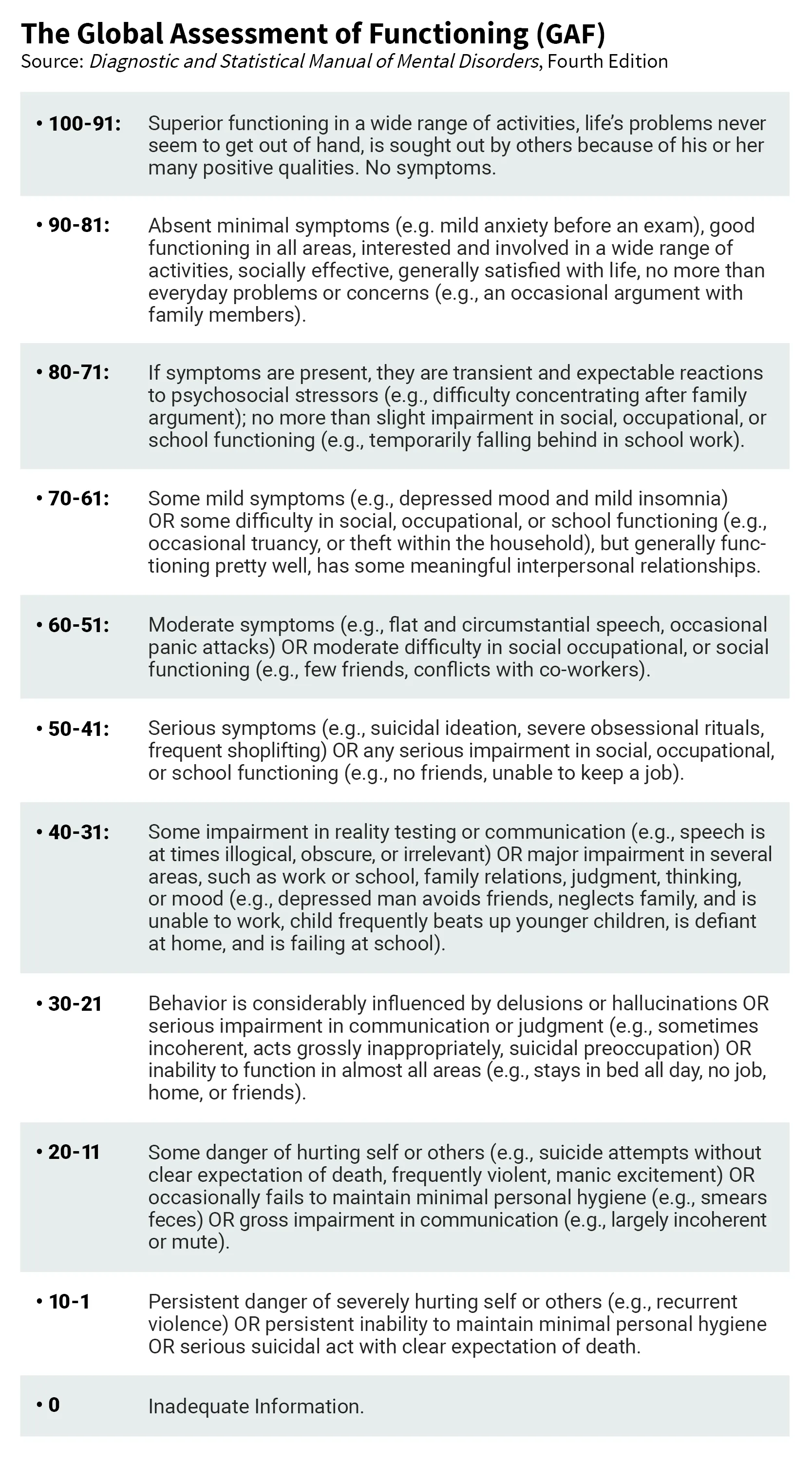
  • 91-100: Excellent functioning, minimal impairment.
  • 71-80: Some difficulty in social/school/work, but generally good.
  • 51-60: Moderate symptoms or moderate difficulty in several areas.
  • 21-30: Constant danger of harming self or others, major impairment.
Usage and limitations
  • Purpose: Helps determine treatment level, monitor progress, and allocate resources.
  • Status: Though removed from DSM-5, it remains widely used by insurance and government bodies.
  • Criticisms: Has faced issues with reliability and validity, prompting revised versions and alternative tools like the WHODAS.

_______________________________________________________

What Is the Global Assessment of Functioning (GAF) Scale? [From WebMD

Medically Reviewed by Smitha Bhandari, MD on January 16, 2025

The Global Assessment of Functioning, or GAF, scale is used to rate how serious a mental illness may be. It measures how much a person’s symptoms affect their day-to-day life on a scale of 0 to 100.

It’s designed to help mental health providers understand how well the person can do everyday activities. The score can help figure out what level of care someone may need and how well certain treatments might work.

The GAF is based on a scale that was first used in 1962. It’s been updated over time. In 2013, the manual that psychiatrists in the U.S. use to define and classify mental disorders dropped it in favor of a scale designed by the World Health Organization. But government agencies and insurance companies, as well as others, still use it and aren’t expected to replace it any time soon.

A GAF rating can be based on many things, including:

  • An interview or questionnaire
  • Medical records
  • Information from the person’s doctor, care givers, or close relatives
  • Police or court records about violent or illegal behavior

It’s broken into 10 sections. These are known as anchor points. The higher your score, the better you’re able to handle daily activities:

gaf chart

This entry was posted in Better? Worse? Or the Same?, Global Assessment Of Functioning (GAF), WHO Disability Assessment Schedule 2.0 (WHODAS 2.0), World Health Organization. Bookmark the permalink.