
In addition to today’s resource, please review The PECARN Pediatric Head Trauma Decision Guidelines Toolkit from The California ACEP.
Between 20% and 60% of children presenting to EDs with head injury undergo head CT in the U.S., even though less than 1% of children with GCS of 14 – 15 have an injury that requires any kind of intervention. Using the PECARN head injury prediction rule can significantly improve the value we deliver to our patients by reducing unnecessary CT scans in children, thereby reducing radiation exposure and decreasing costs.
California ACEP has developed a toolkit to facilitate adoption of the evidence-based PECARN algorithm. The toolkit specifically addresses “shared decision making” as a vital part of PECARN, and spells out how observation can be a safe alternative to CT scanning in low-risk patients. We encourage all emergency providers to utilize the California ACEP PECARN toolkit so all pediatric patients with minor head injuries can benefit from the landmark PECARN study.
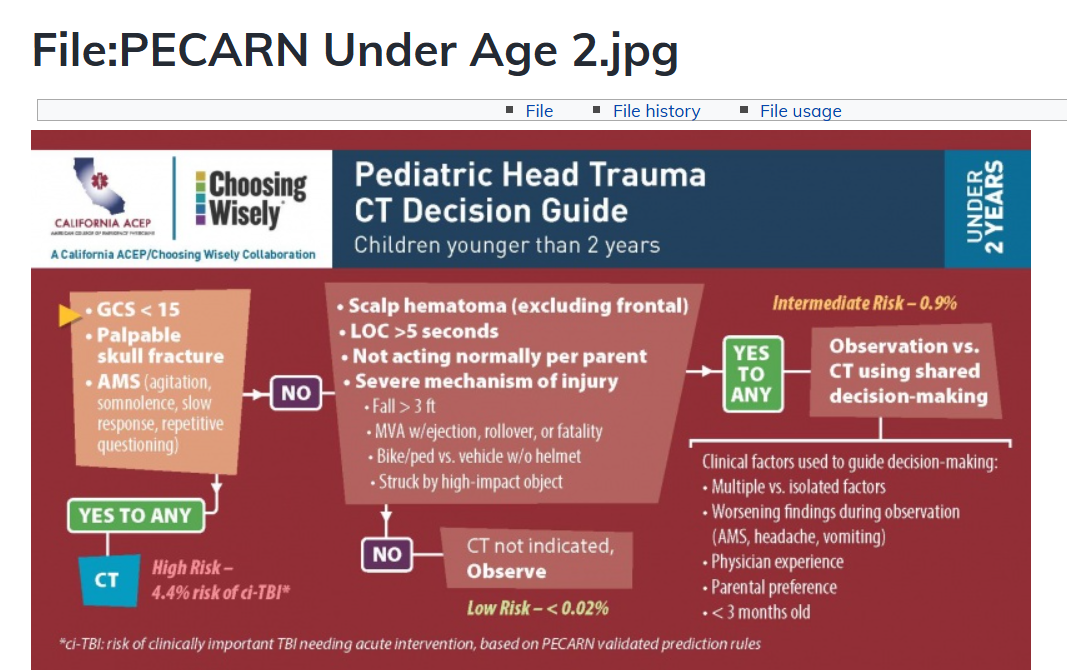
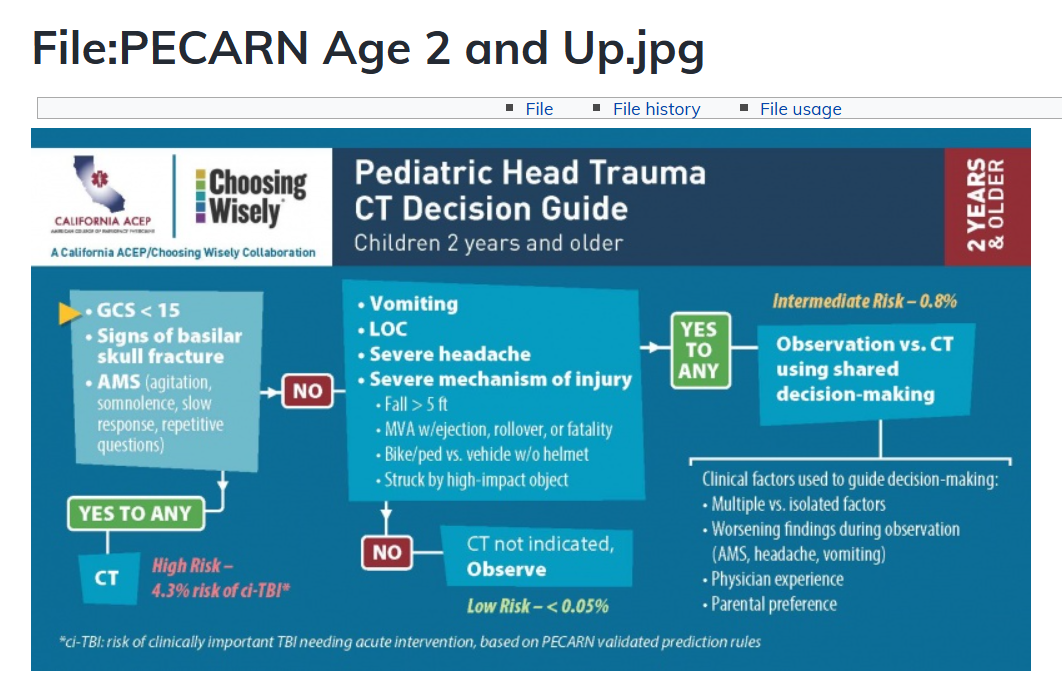
Today, I review, link to, and excerpt from “Identification of children at very low risk of clinicallyimportant brain injuries after head trauma: a prospective cohort study”. [PubMed Abstract] [Full-Text HTML] [Full-Text PDF]. Lancet. 2009 Oct 3;374(9696):1160-70. doi: 10.1016/S0140-6736(09)61558-0. Epub 2009 Sep 14.
There are 101 similar articles in PubMed.
The above article has been cited by 428 articles in PubMed.
All that follows is from the above resource.
Coming today.


