Today, I review, link to, and excerpt from “Alzheimer’s Association recommendations for operationalizing the detection of cognitive impairment during the Medicare Annual Wellness Visit in a primary care setting”. [PubMed Abstract] [Full-Text HTML] [Full-Text PDF]. Alzheimers Dement. 2013 Mar;9(2):141-50. doi: 10.1016/j.jalz.2012.09.011. Epub 2012 Dec 20.
There are 97 similar articles in PubMed.
The above article has been cited by 244 articles in PubMed.
All that follows is from the above article.
- Abstract
- Keywords
- 1. Introduction
- 2. Guiding principles for recommendations
- 3. Review of available brief tools for use during the AWV
- 4. Recommended algorithm for detection of cognitive impairment during the AWV
- 5. Full dementia evaluation
- 6. Discussion
- 7. Author Disclosures
- Supplementary data
- References
Abstract
The Patient Protection and Affordable Care Act added a new Medicare benefit, the Annual Wellness Visit (AWV), effective January 1, 2011. The AWV requires an assessment to detect cognitive impairment. The Centers for Medicare and Medicaid Services (CMS) elected not to recommend a specific assessment tool because there is no single, universally accepted screen that satisfies all needs in the detection of cognitive impairment. To provide primary care physicians with guidance on cognitive assessment during the AWV, and when referral or further testing is needed, the Alzheimer’s Association convened a group of experts to develop recommendations. The resulting Alzheimer’s Association Medicare Annual Wellness Visit Algorithm for Assessment of Cognition includes review of patient Health Risk Assessment (HRA) information, patient observation, unstructured queries during the AWV, and use of structured cognitive assessment tools for both patients and informants. Widespread implementation of this algorithm could be the first step in reducing the prevalence of missed or delayed dementia diagnosis, thus allowing for better healthcare management and more favorable outcomes for affected patients and their families and caregivers.Keywords
Annual Wellness Visit; AWV; Cognitive impairment; Assessment; Screen; Dementia; Alzheimer’s disease; Medicare; Algorithm; Patient Protection and Affordable Care Act1. Introduction
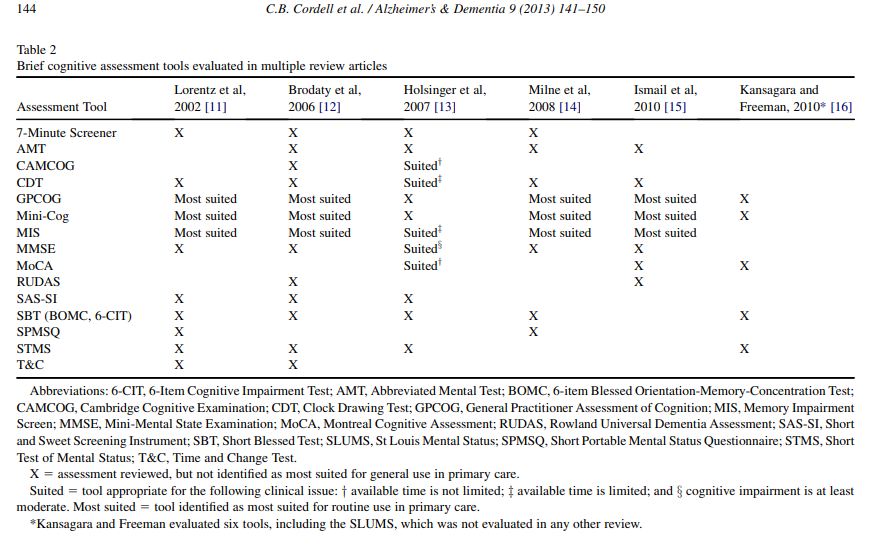
The Patient Protection and Affordable Care Act of 2010 added a new Medicare benefit, the Annual Wellness Visit (AWV), effective January 1, 2011. The AWV includes routine measurements such as height, weight, and blood pressure; a review of medical and family history; an assessment to detect cognitive impairment; and establishment of a list of current medical providers, medications, and schedule for future preventive services. In addition, during the first AWV only, beneficiaries are to be screened for depression (if not completed under a separate Medicare benefit) and for functional difficulties using nationally recognized appropriate screening questions or standardized questionnaires. Although the U.S. Preventive Services Task Force (USPSTF) in 2003 concluded that there was insufficient published evidence of better clinical outcomes as a result of routine screening for cognitive impairment in older adults, the Task Force recognized that the use of cognitive assessment tools can increase the detection of cognitive impairment [1]. As per the Centers for Medicare and Medicaid Services (CMS) regulation, the AWV requires detection of cognitive impairment by “… assessment of an individual’s cognitive function by direct observation, with due consideration of information obtained by way of patient report, concerns raised by family members, friends, caretakers, or others” [2]. During the public comment period, several organizations, including the Alzheimer’s Association, noted that the use of a standardized tool for assessment of cognitive function should be part of the AWV.The use of a brief, structured cognitive assessment tool correctly classifies patients with dementia or mild cognitive impairment (MCI) more often than spontaneous detection by the patients’ own primary care physicians (83% vs 59%, respectively) [8].3. Review of available brief tools for use during the AWV3.2. Workgroup review resultsOf the five publications that focused specifically on
identifying brief cognitive assessments most suitable or
most used in primary care settings [11–15], all selected
the Memory Impairment Screen (MIS), and four of these
publications [11,12,14,15] also selected the General
Practitioner Assessment of Cognition (GPCOG) and the
Mini-Cog (Table 2).The following attributes of the GPCOG, Mini-Cog, and
the MIS contributed to their selection as most suited for routine use in primary care:
- Requires 5 minutes or less to administer.
- Is validated in a primary care or community setting.
- Is easily administered by medical staff members who
are not physicians.- Has good to excellent psychometric properties.
- Is relatively free from educational, language, and/or
culture bias.- Can be used by clinicians in a clinical setting without
payment for copyrights.- Charging a fee for clinical use of brief cognitive assessment tool has become an issue because of increased enforcement of the MMSE copyright.
3.3. Patient structured cognitive assessment tools
recommended for AWVIn alignment with the workgroup’s guiding principles
Table 1 Review articles of brief cognitive assessment tools—select inclusion and comparison criteria and supported by data in the six selected SERs/reviews, the GPCOG, Mini-Cog, and MIS are brief structured tools that are suitable for assessment of cognitive function during the AWV. Each tool has unique benefits. The GPCOG has patient and informant components
that can be used alone or together to increase specificity
and sensitivity [18]. The Mini-Cog has been validated in
population-based studies and in community-dwelling
older adults heterogeneous with respect to language, culture, and education [19–22]. The MIS is a verbally
administered word-recall task that tests encoding as
well as retrieval [23], and is an option for patients who
have motor impairments that prevent use of paper and
pencil.3.4. Structured cognitive assessment tools for use with
informantsCognitive assessment combined with informantreported data improves the accuracy of assessment
[24–27]. If an informant is present during the AWV,
use of a structured informant tool is recommended.
Similar to cognitive assessment tools for use with
patients, there is no single “gold standard” informant
tool; however, relatively few brief informant tools
have been validated in community and/or primary care
settings. Brief tools appropriately validated include the
Short IQCODE [25], the AD8 [28], which can be administered in-person or by telephone, and the aforementioned GPCOG [18], which has both patient and informant components.