
Today, I review, link to, and excerpt from The Cribsiders‘ “#155: New Kids on the Block: Care of the Well Baby in the Newborn Nursery” which is a part of their Pediatric Intern Boot Camp series.
All that follows is from the above resource.
Summary:
Kim Schamel, medical director of the Newborn Assessment Nursery at Washington University/St. Louis Children’s Hospital, walks us through newborn nursery 101! She gives pointers for the newborn physical exam, counseling strategies for safe sleep, gives us a framework for evaluating neonatal weight loss, and so much more. From the golden hour to the discharge talk and everything in between, she reminds us that when it comes to healthy babies, just feed them, love them, and don’t shake them!
Newborn Nursery Pearls
- Caring for a newborn is a team sport – whether with a partner or other support person – and there are a lot of choices during this time that are neither right nor wrong for babies as long as families feed them, love them, and don’t shake them!
- To help keep a newborn calm during their first physical exam, use the radiant warmer for heat and a gloved finger for baby to suck on – start with heart and lungs in case baby devolves before you get to this part!
- Kaiser Sepsis Calculator is your best friend in the first 24 hours – it gives you specific criteria for equivocal and ill-appearing and recommends only a blood culture if equivocal as the CBC has limited sensitivity and specificity this early in life (the best piece of data is right in front of you – look at the baby not the number!)
25:32: Sacral dimples are no big deal. Sacral dimples above the gluteal cleft need evaluation.
See https://pedsneurosurgery.org/wp-content/uploads/2024/11/UW-Health-Kids-Sacral-Dimples-.pdf#:~:text=If%20you%20are%20concerned%20about,or%20pathological%20and%20if%20needed%2C:


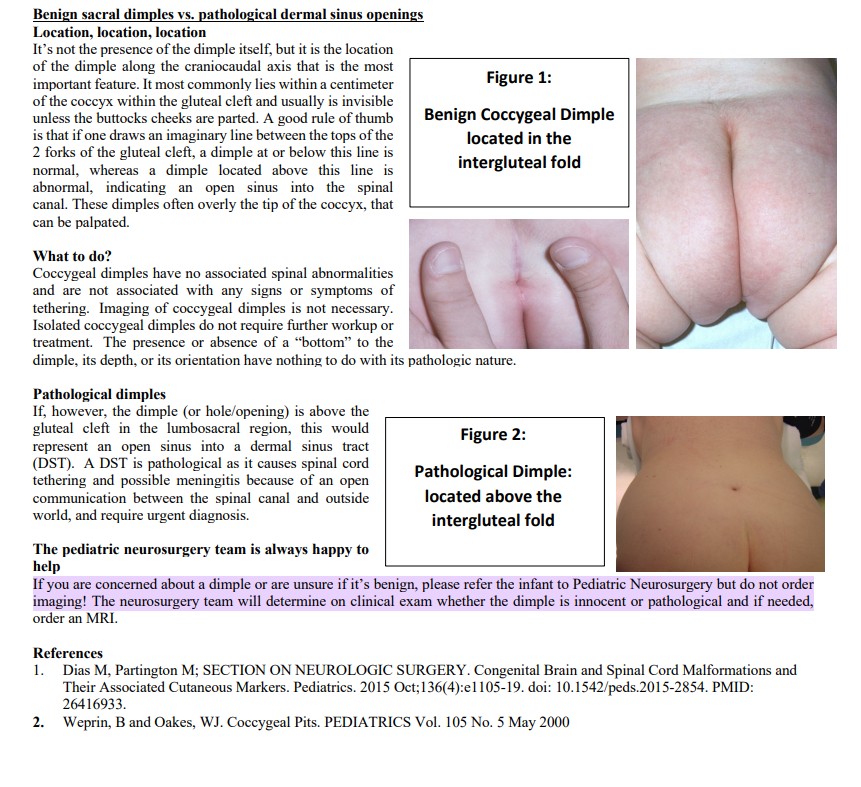
_____________________________________________________________
What follows are links to:
-
#14: Infant Nutrition: Digestible Pearls with Dr. Joan Meek, MD
-
#45: Neonatal Hyperbilirubinemia – Their Future’s So Bright, They Gotta Wear Shades!
-
#131: New Kids on the Block: Special Care Nursery
#14: Infant Nutrition: Digestible Pearls with Dr. Joan Meek, MD
December 9, 2020 | By Justin BerkInfant Nutrition Pearls
- Breastfeeding yields numerous benefits for mom (e.g. decreased risk of diabetes, HTN, breast and ovarian cancer) and baby (e.g. decreased risk of severe diarrhea, otitis media, obesity, lower respiratory tract infections).
- Some families will make an informed choice to use formula feeding; this decision should not be stigmatized. Instead, build trust through communication and support.
- Breastfeeding disparities are rooted in systemic racism including the reverberations from wet nursing and continued inadequate access to nutritional support.
- Try using demonstrations and the teach back method for mixing formula properly.
- When making formula with powder, emphasize the importance of putting the water in first, then adding the formula, in order to maintain the proper concentration.
- Drinking regular cow’s milk before one year of age can cause iron-deficiency anemia.
#45: Neonatal Hyperbilirubinemia – Their Future’s So Bright, They Gotta Wear Shades!
March 2, 2022 | By Sam MasurNeonatal Hyperbilirubinemia Pearls
- Unconjugated neonatal hyperbilirubinemia is very common and can be benign, though frightening, to parents. When you have low concern for other pathophysiology, encourage feeding and supplementation to alleviate starvation jaundice.
- Have a systematic approach to hyperbilirubinemia and keep an open mind, especially with an unexpected clinical course. A good history is key!
- Physical exam skills can identify sources of possible hemolysis, but aren’t always the best for jaundice.
- Equitable care practices include universal bilirubin screening at 24 hours of life, and ensuring robust follow-up after discharge from the birthing center, nursery, or NICU.
- Be judicious with interventions and don’t initiate subthreshold phototherapy.
#131: New Kids on the Block: Special Care Nursery
January 29, 2025 | By Sam MasurSummary:
Dr. Colleen Brennan, academic neonatologist at Washington University and director of neonatal outreach, walks us through the first few hours of a baby’s life when things don’t go as planned! She covers critical topics like recognizing respiratory distress and apnea in a neonate, practical tips for corrective steps in newborn resuscitation, how low is too low in neonatal blood glucose, and when to think about etiologies outside of normal transitional physiology!
Newborn Nursery (Special Care) Pearls
- A newborn without respiratory effort is apneic and needs us to breathe for them!
- When providing positive pressure, look for good, symmetric chest rise with breaths.
- Oxygen saturations should be 70% by 3 minutes of life and can take up to 10 minutes to achieve goal saturations
- If a baby stays on CPAP for more than a few hours (Dr. Brennan uses 6 hours as her cutoff), consider broadening the differential beyond TTN to other common causes of respiratory distress in the newborn like respiratory distress syndrome, pneumonia, pneumothorax, and sepsis (use the Kaiser Permanente neonatal sepsis calculator!).
- Newborns have physiologic hypoglycemia as they go from continuous dextrose in utero to bolus feeds – a term or near-term baby’s blood sugar should be >40 mg/dL in the first 4 hours and >45 mg/dL from 4-48 hours of life.
- The Sugar Babies study showed us that 40% dextrose gel + any kind of feed should be first line treatment for hypoglycemia.


______________________________________________________________
Now we resume the notes from The Cribsiders’ “#155: New Kids on the Block: Care of the Well Baby in the Newborn Nursery”:


