Today, I review, link to, and excerpt from “Vitamin D for the Prevention of Disease: An Endocrine Society Clinical Practice Guideline”. [PubMed Abstract] [Full-Text HTML] [Full-Text PDF]. J Clin Endocrinol Metab. 2024 Jul 12;109(8):1907-1947. doi: 10.1210/clinem/dgae290.
All that follows is from the above resource. Just follow along from the Article Contents below.
Article Contents
Abstract
BackgroundNumerous studies demonstrate associations between serum concentrations of 25-hydroxyvitamin D (25[OH]D) and a variety of common disorders, including musculoskeletal, metabolic, cardiovascular, malignant, autoimmune, and infectious diseases. Although a causal link between serum 25(OH)D concentrations and many disorders has not been clearly established, these associations have led to widespread supplementation with vitamin D and increased laboratory testing for 25(OH)D in the general population. The benefit-risk ratio of this increase in vitamin D use is not clear, and the optimal vitamin D intake and the role of testing for 25(OH)D for disease prevention remain uncertain.
ObjectiveTo develop clinical guidelines for the use of vitamin D (cholecalciferol [vitamin D3] or ergocalciferol [vitamin D2]) to lower the risk of disease in individuals without established indications for vitamin D treatment or 25(OH)D testing.
MethodsA multidisciplinary panel of clinical experts, along with experts in guideline methodology and systematic literature review, identified and prioritized 14 clinically relevant questions related to the use of vitamin D and 25(OH)D testing to lower the risk of disease. The panel prioritized randomized placebo-controlled trials in general populations (without an established indication for vitamin D treatment or 25[OH]D testing), evaluating the effects of empiric vitamin D administration throughout the lifespan, as well as in select conditions (pregnancy and prediabetes). The panel defined “empiric supplementation” as vitamin D intake that (a) exceeds the Dietary Reference Intakes (DRI) and (b) is implemented without testing for 25(OH)D. Systematic reviews queried electronic databases for publications related to these 14 clinical questions. The Grading of Recommendations, Assessment, Development, and Evaluation (GRADE) methodology was used to assess the certainty of evidence and guide recommendations. The approach incorporated perspectives from a patient representative and considered patient values, costs and resources required, acceptability and feasibility, and impact on health equity of the proposed recommendations. The process to develop this clinical guideline did not use a risk assessment framework and was not designed to replace current DRI for vitamin D.
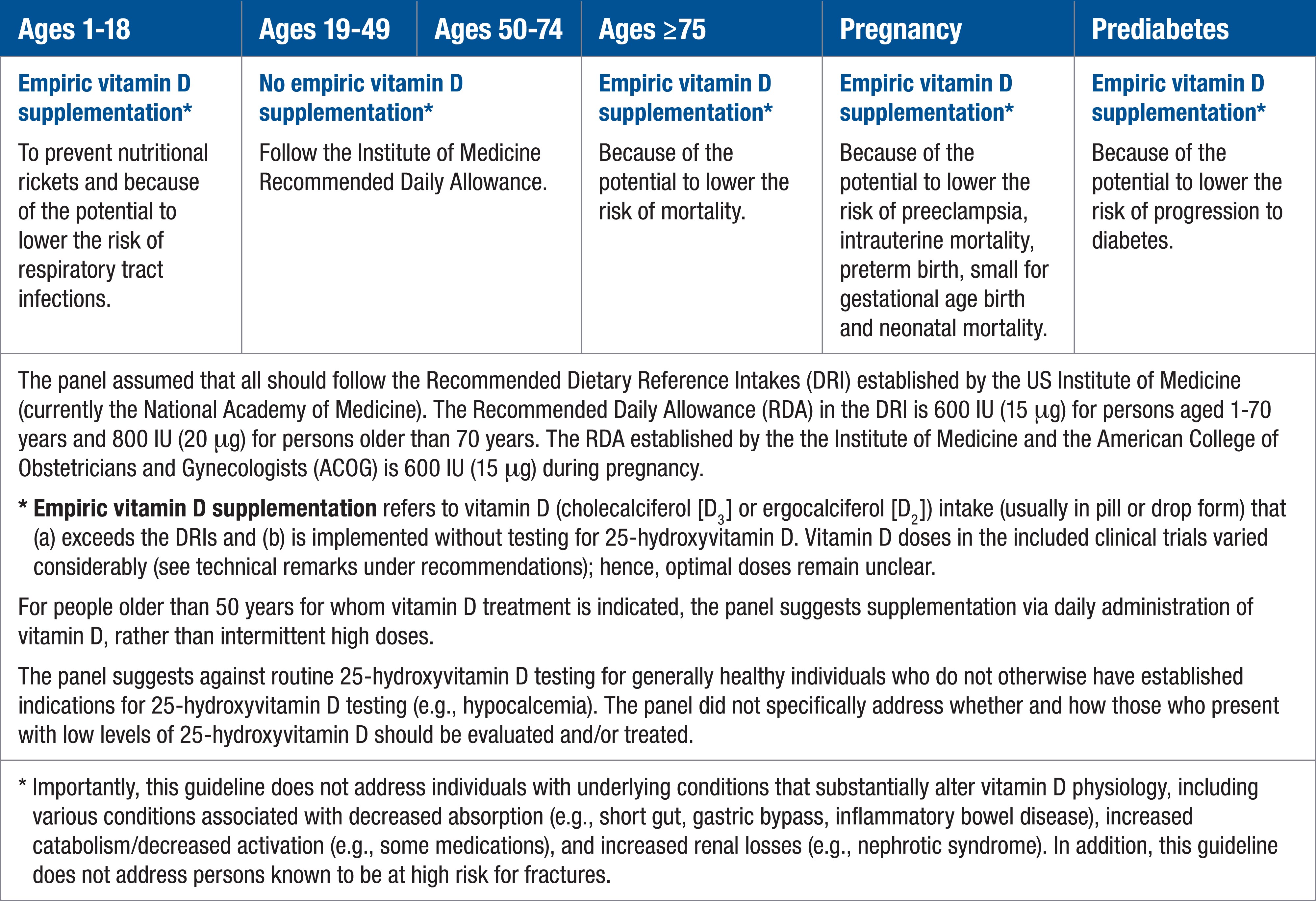
ResultsThe panel suggests empiric vitamin D supplementation for children and adolescents aged 1 to 18 years to prevent nutritional rickets and because of its potential to lower the risk of respiratory tract infections; for those aged 75 years and older because of its potential to lower the risk of mortality; for those who are pregnant because of its potential to lower the risk of preeclampsia, intra-uterine mortality, preterm birth, small-for-gestational-age birth, and neonatal mortality; and for those with high-risk prediabetes because of its potential to reduce progression to diabetes. Because the vitamin D doses in the included clinical trials varied considerably and many trial participants were allowed to continue their own vitamin D–containing supplements, the optimal doses for empiric vitamin D supplementation remain unclear for the populations considered. For nonpregnant people older than 50 years for whom vitamin D is indicated, the panel suggests supplementation via daily administration of vitamin D, rather than intermittent use of high doses. The panel suggests against empiric vitamin D supplementation above the current DRI to lower the risk of disease in healthy adults younger than 75 years. No clinical trial evidence was found to support routine screening for 25(OH)D in the general population, nor in those with obesity or dark complexion, and there was no clear evidence defining the optimal target level of 25(OH)D required for disease prevention in the populations considered; thus, the panel suggests against routine 25(OH)D testing in all populations considered. The panel judged that, in most situations, empiric vitamin D supplementation is inexpensive, feasible, acceptable to both healthy individuals and health care professionals, and has no negative effect on health equity.
ConclusionThe panel suggests empiric vitamin D for those aged 1 to 18 years and adults over 75 years of age, those who are pregnant, and those with high-risk prediabetes. Due to the scarcity of natural food sources rich in vitamin D, empiric supplementation can be achieved through a combination of fortified foods and supplements that contain vitamin D. Based on the absence of supportive clinical trial evidence, the panel suggests against routine 25(OH)D testing in the absence of established indications. These recommendations are not meant to replace the current DRIs for vitamin D, nor do they apply to people with established indications for vitamin D treatment or 25(OH)D testing. Further research is needed to determine optimal 25(OH)D levels for specific health benefits.
vitamin D, 25-hydroxyvitamin D, vitamin D deficiency, mortality, pregnancy, infection, prediabetes, clinical practice guidelines, systematic reviewsIssue Section:Collection: Endocrine Society JournalsLimitations
In formulating this Guideline, several challenges were encountered that influenced the formulation of the final recommendations.
Because those with lower baseline levels of 25(OH)D are expected to benefit more from vitamin D supplementation than those with higher levels (19), a major limitation in formulating recommendations was the paucity of RCTs addressing the efficacy and safety of vitamin D supplementation in populations with low baseline 25(OH)D levels. Average baseline levels of 25(OH)D in many large trials were in a range that most would consider adequate (eg, 31 ng/mL [78 nmol/L] in the VITAL trial) (20). In such trials, a lack of effect of vitamin D does not necessarily indicate that vitamin D does not influence the relevant outcome, but rather that the study populations had baseline levels of 25(OH)D that were adequate for the desired outcome.
Unlike typical trials for pharmacologic agents, in which control participants are not exposed to the intervention, all participants in vitamin D trials were routinely exposed to vitamin D through sun exposure and dietary sources. In addition, many trials allowed participants to remain on their current supplements that contained vitamin D which often reflected the DRI (eg, 600-800 IU [15-20 μg] daily for adults). Such circumstances may have biased trial results toward the null hypothesis.
Most vitamin D trials did not include a specific 25(OH)D level as an eligibility criterion, and no trials were designed or powered to address the effect of vitamin D in subgroups stratified by either baseline or achieved 25(OH)D levels. This prevented the panel from proposing thresholds for 25(OH)D adequacy or providing target 25(OH)D levels for disease prevention, especially since 25(OH)D thresholds are likely to vary by population and outcome. Although many systematic reviews include subgroup analyses according to the study average baseline 25(OH)D levels, such analyses are subject to ecological fallacy in which inferences about individuals are based on aggregate group data. Therefore, the commissioned systematic review informing this guideline does not include study subgroup analyses according to average baseline 25(OH)D levels.
Many trials were considered to be of insufficient duration to adequately assess the effect of the vitamin D intervention on some outcomes, due to the long latency for the development of chronic diseases such as cancer, diabetes, cardiovascular disease (CVD) and osteoporosis.
Because the included trials used various doses and administration schedules of vitamin D, specific dose recommendations for vitamin D could not be proposed for specific populations. Instead, in the technical remarks, vitamin D doses used in the included trials are summarized.
The trials that the panel considered were performed in overall healthy populations at average risk for the outcomes of interest; therefore, the recommendations are limited to generally healthy individuals without established indications for vitamin D treatment or 25(OH)D testing.
In most trials, study participants were largely of European ancestry or identified as non-Hispanic White, with very few trials including large numbers of participants from other races or ethnicities.
The panel developed clinical questions for different age groups of adults (<50 years, 50 to 74 years, and 75 years and older) to represent different stages of life. However, the panel recognizes the somewhat arbitrary nature of these categories and acknowledges that many trials included populations that spanned these age categories. As a result, it was challenging to directly apply study results to narrowly defined age groups.
Many trials in those aged older than 50 years combined vitamin D with calcium, making it difficult to isolate the effect of vitamin D from that of calcium. This is especially relevant to outcomes related to skeletal health, for which both vitamin D and calcium are considered essential.
Due to resource limitations, not all potential outcomes of interest were addressed in all populations of interest. The panel prioritized outcomes that they felt were most relevant to the specific populations under consideration.
Thus, these clinical guidelines relate to the use of vitamin D to lower the risk of disease in individuals without established indications for vitamin D treatment or 25(OH)D testing. The Guideline Development Panel assumed that the Institute of Medicine’s (IOM, now known as the National Academy of Medicine) DRIs for vitamin D (21) represent a baseline standard for all individuals. Importantly, the panel’s recommendations should not be extrapolated to those with underlying medical conditions that are known to negatively impact vitamin D physiology. For those living in countries where food fortification with vitamin D is not standard or where dietary supplements are not routinely used, interventions may be required to insure a baseline intake consistent with the IOM DRIs.
List of Recommendations
Question 1. Should empiric vitamin D supplementation vs no empiric vitamin D supplementation be used for children and adolescents (ages 1 to 18 years)?
Recommendation 1In children and adolescents aged 1 to 18 years, we suggest empiric vitamin D supplementation to prevent nutritional rickets and potentially lower the risk of respiratory tract infections. (2 | ⊕⊕◯◯)
Technical remarks
Empiric vitamin D may include daily intake of fortified foods, vitamin formulations that contain vitamin D, and/or daily intake of a vitamin D supplement (pill or drops).
In the clinical trials included in the systematic review, with respect to respiratory tract infections in children, vitamin D dosages ranged from 300 to 2000 IU (7.5 to 50 μg) daily equivalent. The estimated weighted average was approximately 1200 IU (30 μg) per day.
Question 2. Should empiric vitamin D supplementation vs no empiric vitamin D supplementation be used for nonpregnant adults < 50 years of age?
Question 3. Should vitamin D supplementation vs no vitamin D supplementation be used for nonpregnant adults < 50 years of age only when 25(OH)D levels are below a threshold?
Recommendation 2In the general adult population younger than age 50 years, we suggest against empiric vitamin D supplementation beyond the recommended Dietary Reference Intake for this population. (2 | ⊕◯◯◯)
Technical remark
This recommendation relates to empiric vitamin D supplementation that exceeds the DRIs established by the IOM. Adults in this age group should follow the Recommended Daily Allowance established by the IOM (600 IU [15 µg] daily).
Recommendation 3In the general adult population younger than age 50 years, we suggest against routine 25(OH)D testing. (2 | ⊕◯◯◯)
Technical remarks
In this population, 25(OH)D levels that provide outcome-specific benefits have not been established in clinical trials.
The panel suggests against (a) routine screening for a 25(OH)D level to guide decision-making (ie, vitamin D vs no vitamin D) and (b) routine follow-up testing for 25(OH)D level to guide vitamin D dosing.
This recommendation relates to generally healthy adults who do not otherwise have established indications for 25(OH)D testing (eg, hypocalcemia).
Question 4. Should empiric vitamin D supplementation vs no empiric vitamin D supplementation be used for adults aged 50 to 74 years?
Question 5. Should vitamin D supplementation vs no vitamin D supplementation be used for adults aged 50 to 74 years only when 25(OH)D levels are below a threshold?
Recommendation 4In the general population aged 50 to 74 years, we suggest against routine vitamin D supplementation beyond the recommended Dietary Reference Intake for this population. (2 | ⊕⊕⊕◯)
Technical remark
This recommendation relates to empiric vitamin D supplementation that exceeds the DRIs established by the IOM. Adults in this age group should follow the Recommended Daily Allowance established by the IOM (600 IU [15 µg] daily for those aged 50 to 70 years; 800 IU [20 µg] daily for those older than 70 years).
Recommendation 5In the general population aged 50 to 74 years, we suggest against routine 25(OH)D testing. (2 | ⊕◯◯◯)
Technical remarks
In this population, 25(OH)D levels that provide outcome-specific benefits have not been established in clinical trials.
The panel suggests against (a) routine screening for a 25(OH)D level to guide decision-making (ie, vitamin D vs no vitamin D) and (b) routine follow-up testing for 25(OH)D level to guide vitamin D dosing.
This recommendation relates to generally healthy adults who do not otherwise have established indications for 25(OH)D testing (eg, hypocalcemia).
Question 6. Should empiric vitamin D supplementation vs no empiric vitamin D supplementation be used by adults aged ≥ 75 years?
Question 7. Should vitamin D supplementation vs no vitamin D supplementation be used by adults aged ≥ 75 years only when 25(OH)D levels are below a threshold?
Recommendation 6In the general population aged 75 years and older, we suggest empiric vitamin D supplementation because of the potential to lower the risk of mortality. (2 | ⊕⊕⊕◯)
Technical remarks
Empiric vitamin D may include daily intake of fortified foods, vitamin formulations that contain vitamin D and/or daily intake of a vitamin D supplement.
For empiric supplementation, daily, lower-dose vitamin D is preferred over nondaily, higher doses.
In the clinical trials included in the systematic review that reported on the mortality outcome, vitamin D dosage ranged from 400 to 3333 IU (10 to 83 μg) daily equivalent. The estimated weighted average was approximately 900 IU (23 μg) daily. Participants in many trials were allowed to remain on their routine supplements, including up to 800 IU (20 µg) of vitamin D daily.
Recommendation 7In the general population aged 75 years and older, we suggest against routine testing for 25(OH)D levels. (2 | ⊕◯◯◯)
Technical remarks
In this population, 25(OH)D thresholds that provide outcome-specific benefits have not been established in clinical trials.
The panel suggests against (a) routine screening for a 25(OH)D level to guide decision-making (ie, vitamin D vs no vitamin D) and (b) routine follow-up testing for 25(OH)D level to guide vitamin D dosing.
This recommendation relates to generally healthy adults who do not otherwise have established indications for 25(OH)D testing (eg, hypocalcemia).
Question 8. Should empiric vitamin D supplementation vs no empiric vitamin D supplementation be used during pregnancy?
Question 9. Should vitamin D supplementation vs no vitamin D supplementation be used during pregnancy only when 25(OH)D levels are below a threshold?
Recommendation 8We suggest empiric vitamin D supplementation during pregnancy, given its potential to lower risk of preeclampsia, intra-uterine mortality, preterm birth, small-for-gestational-age (SGA) birth, and neonatal mortality. (2 | ⊕⊕◯◯)
Technical remarks
This recommendation is based on evidence from trials conducted in healthy individuals during pregnancy.
Empiric vitamin D may include daily intake of fortified foods, prenatal vitamin formulations that contain vitamin D, and/or a vitamin D supplement (pills or drops).
In the clinical trials included in the systematic review, the vitamin D dosages ranged from 600 IU to 5000 IU (15 to 125 μg) daily equivalent, usually provided daily or weekly. The estimated weighted average was approximately 2500 IU (63 μg) per day.
Recommendation 9During pregnancy, we suggest against routine 25(OH)D testing. (2 | ⊕◯◯◯)
Technical remarks
In this population, 25(OH)D levels that provide pregnancy outcome-specific benefits have not been established in clinical trials.
The panel suggests against (a) routine screening for a 25(OH)D level to guide decision-making (ie, vitamin D vs no vitamin D) and (b) routine follow-up testing for 25(OH)D level to guide vitamin D dosing.
This recommendation relates to generally healthy pregnant individuals who do not otherwise have established indications for 25(OH)D testing (eg, hypocalcemia).
Question 10. Should empiric vitamin D supplementation vs no empiric vitamin D supplementation be used for adults with prediabetes (by glycemic criteria)?
Recommendation 10For adults with high-risk prediabetes, in addition to lifestyle modification, we suggest empiric vitamin D supplementation to reduce the risk of progression to diabetes. (2 | ⊕⊕⊕◯)
Technical remarks
Lifestyle modification must be a routine management component for adults with prediabetes.
The clinical trials informing this recommendation primarily related to adults with high-risk prediabetes, identified as meeting 2 or 3 American Diabetes Association glycemia criteria (fasting glucose, glycated hemoglobin [HbA1c], 2-hour glucose after a 75-gram oral glucose challenge) for prediabetes and those with impaired glucose tolerance.
In the clinical trials included in the systematic review, the vitamin D dosages ranged from 842 to 7543 IU (21 to 189 μg) daily equivalent. The estimated weighted average was approximately 3500 IU (88 μg) per day. Participants in some trials were allowed to remain on their routine supplements, including up to 1000 IU (25 µg) of vitamin D daily.
Question 11. Should a daily, lower-dose vitamin D vs nondaily (ie, intermittent), higher-dose vitamin D be used for nonpregnant people for whom vitamin D treatment is indicated?
Recommendation 11In adults aged 50 years and older who have indications for vitamin D supplementation or treatment, we suggest daily, lower-dose vitamin D instead of nondaily, higher-dose vitamin D. (2 | ⊕⊕◯◯)
Technical remark
The panel did not identify evidence related to individuals younger than age 50 years.
Question 12. Should screening with a 25(OH)D test (with vitamin D supplementation/treatment only if below a threshold) vs no screening with a 25(OH)D test be used for healthy adults?
Recommendation 12In healthy adults, we suggest against routine screening for 25(OH)D levels. (2 | ⊕◯◯◯)
Technical remarks
In healthy adults, 25(OH)D levels that provide outcome-specific benefits have not been established in clinical trials.
This recommendation relates to adults who do not otherwise have established indications for testing with 25(OH)D levels (eg, hypocalcemia).
Recommendation 13In adults with dark complexion, we suggest against routine screening for 25(OH)D levels. (2 | ⊕◯◯◯)
Technical remarks
This recommendation relates to generally healthy adults with dark complexion who do not otherwise have established indications for 25(OH)D testing (eg, hypocalcemia).
The panel did not identify any clinical trials that related clinical outcomes to skin complexion per se. A secondary analysis did not clearly suggest net benefit with vitamin D in those who self-identify as Black. The panel recognized that self-identified race is an inaccurate and otherwise problematic proxy for dark complexion.
Question 14. Should screening with a 25(OH)D test (with vitamin D supplementation/treatment only if below a threshold) vs no screening with a 25(OH)D test be used for adults with obesity?
Recommendation 14In adults with obesity, we suggest against routine screening for 25(OH)D levels. (2 | ⊕◯◯◯)
Technical remarks
In adults with obesity, 25(OH)D thresholds that provide outcome-specific benefits have not been established in clinical trials.
This recommendation relates to generally healthy adults with obesity who do not otherwise have established indications for 25(OH)D testing (eg, hypocalcemia).
Notes:
The Guideline Development Panel did not find clinical trial evidence that would support establishing distinct 25(OH)D thresholds tied to outcome-specific benefits in the populations examined. Hence, the Endocrine Society no longer endorses the target 25(OH)D level of 30 ng/mL (75 nmol/L) suggested in the previous guideline (15). Similarly, the Endocrine Society no longer endorses specific 25(OH)D levels to define vitamin D sufficiency, insufficiency, and deficiency.
The current guideline suggests against routine 25(OH)D screening (in the absence of well-established indications), including in adults and children with obesity, in adults and children with dark complexion, and during pregnancy. This also represents a change from the 2011 guideline (15).