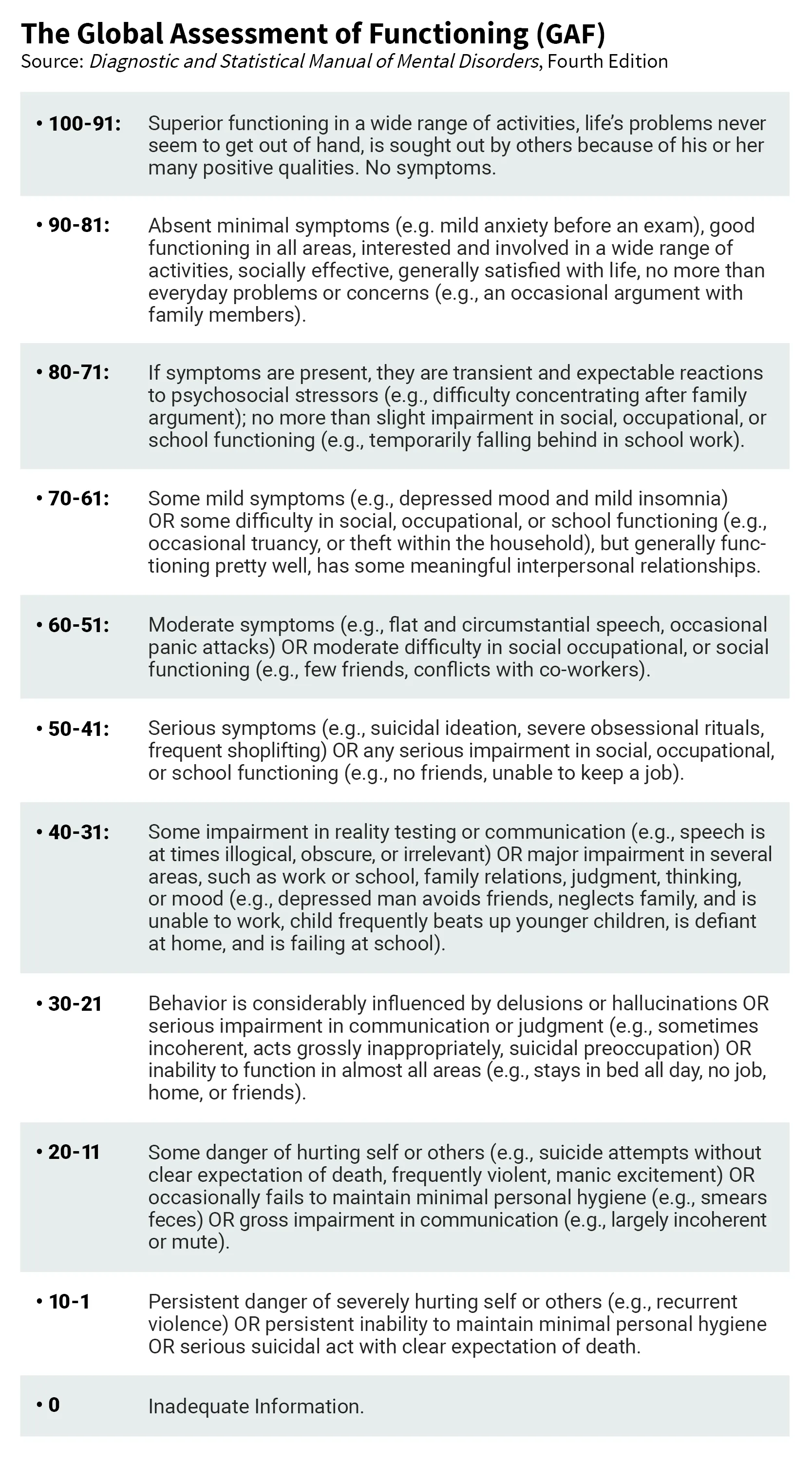
a 0-100 scale mental health clinicians use to rate an individual’s overall psychological, social, and occupational functioning, reflecting symptom severity and ability to handle daily life, with higher scores (e.g., 91-100) indicating superior functioning and lower scores (e.g., 1-20) showing severe impairment or danger, though it was replaced by WHODAS in the DSM-5, many agencies still use it for treatment planning and resource allocation.
How it works
Scale: A single numerical score from 1 (severely impaired) to 100 (superior functioning).
Assessment: Clinicians assess psychological, social, and occupational domains, focusing on symptom severity and functional impairment.
Scoring: Based on clinical interviews, records, and informant data, aiming for the worse of symptom severity or functional impairment.
Dual scales: Some systems use separate scores for symptoms (GAF-S) and functioning (GAF-F).
The Global Assessment of Functioning, or GAF, scale is used to rate how serious a mental illness may be. It measures how much a person’s symptoms affect their day-to-day life on a scale of 0 to 100.
It’s designed to help mental health providers understand how well the person can do everyday activities. The score can help figure out what level of care someone may need and how well certain treatments might work.
The GAF is based on a scale that was first used in 1962. It’s been updated over time. In 2013, the manual that psychiatrists in the U.S. use to define and classify mental disorders dropped it in favor of a scale designed by the World Health Organization. But government agencies and insurance companies, as well as others, still use it and aren’t expected to replace it any time soon.
The Scale
A GAF rating can be based on many things, including:
An interview or questionnaire
Medical records
Information from the person’s doctor, care givers, or close relatives
Police or court records about violent or illegal behavior
It’s broken into 10 sections. These are known as anchor points. The higher your score, the better you’re able to handle daily activities: