Early-onset gastrointestinal (eoGI) cancer is typically defined as GI cancer diagnosed in individuals younger than age 50 years. The incidence of eoGI cancer is rising globally, and eoGI cancers represent the most rapidly increasing early-onset cancer in the U.S.
Observations:
Worldwide, among eoGI cancers reported in 2022, colorectal cancer (CRC) was the most common (54.3%, 184,709 cases), followed by gastric cancer (23.8%, 80,885 cases), esophageal cancer (13.2%, 45,056 cases), and pancreatic cancer (8.6%, 29,402 cases). In the U.S., among eoGI cancers reported in 2022, 20,805 individuals were diagnosed with eoCRC, 2,689 with eo-gastric, 2,657 with eo-pancreatic, and 875 with eo-esophageal cancer. Most eoGI cancers are associated with modifiable risk factors including obesity, poor-quality diet (e.g., sugar-sweetened beverages, ultra-processed foods), sedentary lifestyle, cigarette smoking, and alcohol consumption. Non-modifiable risk factors include family history, hereditary syndromes (e.g., Lynch syndrome), and inflammatory bowel disease for patients with eoCRC. Approximately 15–30% of eoGI cancers have pathogenic germline variants in genes such as DNA mismatch repair genes and BRCA1/2. All patients with eoGI cancers should undergo germline and somatic genetic testing to guide treatment, screen for other cancers (e.g., endometrial cancer in Lynch syndrome), and assess familial risk. Treatment for eoGI cancers are similar to later-onset GI cancers, and may include chemotherapy, surgery, radiation, and therapies such as poly (ADP-ribose) polymerase inhibitors for BRCA-associated pancreatic cancer. Compared with GI cancers diagnosed after age 50, patients with eoGI cancers typically receive more treatments but often have similar or shorter survival. Specialized centers and multidisciplinary teams can support patients with challenges around fertility preservation, parenting with cancer, financial difficulty, and psychosocial distress. Currently, screening is not recommended for most eoGI cancers, although in the U.S., screening for CRC is recommended for average-risk individuals starting at age 45. High-risk individuals (e.g., those with Lynch syndrome, first-degree relative with CRC or advanced colorectal adenoma) should begin CRC screening earlier, at an age determined by the specific risk factor.
Conclusions and Relevance:
eoGI cancers, typically defined as cancer diagnosed in individuals younger than age 50 years, are among the largest subset of early-onset cancers globally. Treatment is similar to later-onset GI cancers and typically involves a combination of chemotherapy, surgery, and radiation, depending on the cancer type and stage. The prognosis of patients with eoGI cancers is similar to or worse than that of later-onset GI cancers, highlighting the need for improved methods of prevention and early detection.
Keywords: early-onset cancer, pancreatic cancer, gastric cancer, esophageal cancer, colorectal cancer, early-onset colorectal cancer, young-onset colorectal cancer, screening, public health
Introduction
Early-onset gastrointestinal (eoGI) cancers are GI cancers diagnosed in adults younger than age 50 years.1 From 2010–2019, the age-standardized incidence rate of eoGI cancers in the U.S. increased from 11.49 to 13.65 per 100,000 population, corresponding to an annual percent change (APC) of 2.16% (95% CI, 1.66–2.67%; P<.001) and representing the most rapidly rising type of early-onset cancer.2 The increasing incidence of early-onset colorectal cancer (eoCRC) led the U.S. Preventive Services Task Force (USPSTF) to lower the recommended age for initiating CRC screening from 50 to 45 years for “average-risk” individuals (described below) in 2021.3 The increase in eoGI cancers follows a birth cohort effect, with generational variation in risk,4 suggesting a potential association with changes in environmental exposures.5
CRC, pancreatic cancer, and esophagogastric cancer are the most common eoGI cancers,6 but recent reports also suggest a rising incidence of early-onset appendix,2 small bowel,2 biliary tract,2 and neuroendocrine cancers.7 However, published data on these rarer eoGI cancers are limited to small, single-center retrospective studies, and are therefore not discussed in this review. Although the incidence of GI cancers has also increased among children and adolescents,8 this review summarizes current evidence on adults aged 18–49 years with eoCRC, eo-pancreatic cancer, and eo-esophagogastric cancer.
Methods
A PubMed search was performed for English-language clinical trials, meta-analyses, systematic reviews, observational studies, narrative reviews, and guidelines on early-onset CRC, pancreatic, and esophagogastric cancers published between January 1, 2014 and March 7, 2025. We prioritized recent, high-quality original research and excluded studies that did not include individuals aged 18–50 years. Of the 1,693 articles retrieved, 118 were included (1 clinical trial, 6 meta-analyses, 2 systematic reviews, 86 observational studies, 7 narrative reviews, and 16 guidelines). We also used 3 publicly available cancer statistics databases: Surveillance, Epidemiology, End Results (SEER) program of the National Cancer Institute,6 U.S. Cancer Statistics Data Visualizations Tool,9 and GLOBOCAN 2022 database version 1.1 from the International Agency for Research on Cancer.10,11
Early-Onset Colorectal Cancer (eoCRC)
Epidemiology
Although CRC incidence among U.S. individuals of all ages has declined by 1.3–4.2% annually since the mid-1990s,12 the incidence of eoCRC has increased by approximately 2% annually,12 and currently represents 14% of all CRC cases.6 The age-adjusted incidence rate (AAIR) and average annual percent changes (AAPC) of eoCRC from SEER are presented in Table 1. Similarly, while CRC-associated mortality in the U.S. has decreased by 1.7% per year, likely due to increased screening and improved treatments13, eoCRC-associated death rates increased by 1% per year (2011–2020).14 In 2022, among U.S. individuals aged 20–49 years, CRC was the leading cause of cancer-related death among men (2,073 deaths) and the second among women (1,604 deaths).13 Although lowering the CRC screening age to 45 years may improve early detection and prevention of eoCRC, the steepest increase in annual eoCRC rates are among those under age 4015 (4.1 to 5.5 per 100,000 [2013–2022], AAPC 3.4% [95% CI 2.4–3.8]).6
Table 1.
Annual Incident Cases of Early-Onset Gastrointestinal Cancers in the U.S. by Sex, with Age-Adjusted Incidence Rates per 100,000 Population Shown in Parentheses (For Year 2022) and Average Annual Percentage Change (AAPC, 2018–2022) as Reported in the SEER Registrya,b
Organ Site
Annual Incident Cases and Incidence (per 100,000), for 2022, age <50 years, Female
AAPC (95% CI), 2018 – 2022, Female
Annual Incident Cases and Incidence (per 100,000), for 2022, age <50 years, Male
Abbreviations: SEER=Surveillance, Epidemiology, End Results
a This table includes individuals <50 years and is not restricted to 20–49 years due to the availability of data. The data represent nationally representative cancer statistics obtained from the Surveillance, Epidemiology, and End Results Program of the National Cancer Institute. The table is ordered by declining annual incidence per 100,000, Standardized to the 2000 U.S. Standard Population.6
b Positive AAPC values denote an increasing trend in incidence over the time period, while negative values represent a decline.
c Combines esophageal adenocarcinoma and squamous cell carcinoma.
eoCRC incidence is also increasing globally since the 1990s, particularly in high-income countries, including Australia, New Zealand, and South Korea.16 Worldwide, there were 184,709 new eoCRC cases reported in 2022, representing 40% of all eoGI cancers,10,11 with the largest increases in New Zealand (AAPC 3.97%, 95% CI 2.44–5.52, 2007–2017).16
Compared to females, U.S. males have a higher incidence of eoCRC (male-to-female incidence rate ratio of 1.20, 95% CI, 1.18–1.22).14 Rates are increasing in all racial and ethnic groups. From 2013–2022, AAPC in eoCRC incidence was 5.1% for Hispanics (AAIR 5.5 to 8.9 per 100,000), 3.3% for non-Hispanic Whites (AAIR 7.8 to 10.9), and 4.7% for non-Hispanic Blacks (AAIR 8.2 to 10.4).6 Compared to later-onset CRC, patients with eoCRC are more likely to be Black (15% vs. 11%) or Hispanic (9% vs. 5%) than White (70% vs 80%).17
Risk Factors
Modifiable risk factors associated with eoCRC (Table 2) include exposure to carcinogens such as cigarette smoke18 and alcohol,19 and certain dietary and lifestyle exposures starting in early life such as processed meat, sugar-sweetened beverages,20–23 obesity,24 and sedentary behavior.25 In the Nurses’ Health Study (NHS) II prospective cohort of 29,474 women, individuals in the highest quintile of Western dietary pattern,26 including intake of processed meat (e.g., canned meat, sausages), red meat, butter, high-fat dairy products (e.g., heavy cream, desserts), eggs, and refined grains (e.g., white bread, white rice), had a significantly increased risk of early-onset high-risk colorectal adenomas, with 300 cases identified in the highest intake group compared to 183 in the lowest (odds ratio, OR, 1.67, 95% CI, 1.18–2.37).21 Among 95,464 women in the NHS II prospective cohort, consumption of ≥2 servings/day of sugar-sweetened beverages was associated with a higher risk of eoCRC compared with <1 serving/week (16 cases per 138,469 person-years vs 45 cases per 536,446 person-years; relative risk, RR 2.18, 95% CI, 1.10–4.35).22 Conversely, among 116,429 women in NHS II, higher total vitamin D (dietary and supplemental) intake (≥450 vs <300 IU/day) was associated with a lower risk of eoCRC (27 cases per 406,189 person-years vs 64 cases per 528,107 person-years; hazards ratio, HR, 0.49, 95% CI, 0.26–0.83).23
Table 2.
Screening Recommendations and Modifiable Risk Factors for Early-Onset GI Cancers (diagnosis at age <50 years)a,b
Early-Onset Colorectal Cancer
Early-Onset Pancreatic Cancer
Early-Onset Esophagogastric Cancer
Screening Recommendations
While some countries, such as Austria and Italy, start screening at age 40 years,48 and the U.S. at age 45 years (USPSTF guidelines),3 most other countries start screening at age 50 years. Recommendations vary by region and risk factors.d
Both U.S. (American College of Gastroenterology74, American Gastroenterology Assocation67) and international guidelines (International Cancer of the Pancreas Screening Consortium75) recommend screening only for high-risk individuals (e.g., inherited genetic syndromes, familial pancreatic cancer), with age varying by risk factors (e.g., begin at age 50 years, or 10 years younger than the initial age of familial onset; age 40 years in CKDN2A and PRSS1 gene variant carriers with hereditary pancreatitis; age 35 years with Peutz–Jeghers syndrome)67
Routine EGD screening for eoEGC is not currently performed in most countries. However, in South Korea, biennial screening for gastric cancer with EGD or upper gastrointestinal series begins at age 40 years.99 The American College of Gastroenterology recommends a single screening EGD for individuals with chronic GERD symptoms and at least 3 of the following risk factors: male sex, age >50 years, White race, tobacco use, obesity, and family history of Barrett’s esophagus or esophageal adenocarcinoma in a first-degree relative.100 Taipei Global Consensus guidelines endorse mass screening and eradication of H. pylori in individuals aged 20–40 years in regions with a high incidence or high risk of gastric cancer.101
a Preference was given to high-quality meta-analyses and large prospective cohort studies where available. Definitions of terms are included where available.
b Early-onset defined as age at diagnosis <50 years; later-onset defined as age at diagnosis >50; unless otherwise noted.
c The incidence is without screening for majority of the population since the U.S. screening guidelines for eoGI cancers in average-risk individuals apply only to patients with CRC in the 45–49 age group.
d Individuals without a personal history of CRC, inflammatory bowel disease, hereditary CRC syndromes, other CRC predisposing conditions, or a family history of CRC.3
e OR, RR, and HR apply to groups with vs. without exposure to risk factors, unless otherwise specified. Definitions per the referenced studies are included where available. The risk factors are ordered by numerical value (descending) for eoCRC and prioritizing those with the most data across cancers.
Obesity, an established CRC risk factor,27 may be contributing to increasing eoCRC rates given the rising prevalence of both childhood and adult obesity worldwide.28,29 Proposed mechanisms of adiposity-induced carcinogenesis include chronic inflammation and insulin resistance, among others.30 In a meta-analysis of 12 studies with 242,561 participants aged ≤55 years, the OR for eoCRC was 1.32 (95% CI, 1.19–1.47) among individuals with overweight (BMI 25–29.9 kg/m2) and 1.88 (95% CI, 1.40–2.54) with obesity (BMI >30 kg/m2), vs. those with BMI <25 kg/m2.24 Moreover, childhood and adolescent obesity (HR 1.53; 95% CI, 1.17–2.0)31 and maternal obesity (HR 2.51, 95% CI, 1.05–6.02)32 are also associated with increased eoCRC risk.
Inflammatory bowel disease (IBD) is also more common among individuals with eoCRC (3%) compared with later-onset CRC (0.4%), OR 2.97 (95% CI, 1.16–6.63).33Although most eoCRC is sporadic, a higher proportion of patients with eoCRC (14–34%) report a family history of CRC diagnosed at any age compared with later-onset CRC (8–19%) across multiple studies.7,34–38
Molecular Features
The prevalence of germline variants is higher among patients with eoCRC (16–25%) vs. later-onset CRC (approximately 10%), primarily due to Lynch syndrome.35,39–41 eoCRC tumors more often harbor a high level of microsatellite instability due to germline alterations in DNA mismatch repair genes (MLH1, MSH2, MSH6, PMS2) that characterize Lynch syndrome, or less commonly through sporadic MLH1 methylation.35,39–42 These genetic alterations lead to defective DNA replication and accumulation of short tandem repeats (microsatellites). Other hereditary syndromes include familial adenomatous polyposis (FAP), MUTYH-associated polyposis, and hamartomatous polyposis syndromes.43 Studies have reported a higher frequency of somatic genomic alterations involving TP53 and CTNNB1 and a lower frequency of APC, KRAS, and BRAF variants among individuals with microsatellite stable eoCRC compared to later-onset CRC.42,44,45
Screening
In 2021, the USPSTF lowered the recommended age for initiation of CRC screening with stool-based tests (e.g., fecal immunochemical test) and/or direct visualization tests (e.g., colonoscopy, flexible sigmoidoscopy) from 50 to 45 years for “average-risk” individuals (i.e., no prior diagnosis of CRC, adenomatous polyps, or IBD; no personal or family history of genetic disorders predisposing to CRC).3 The modeling study informing this update reported that lowering the screening age from 50 to 45 years resulted in an estimated 22–27 additional life-years gained per 1,000 individuals, with a minimal increase in complications (0.1–2 per 1,000 individuals).46 The U.S. Multi-Society Task Force recommends that people with a family history of CRC (including eoCRC) or advanced adenoma (defined as adenoma ≥1 cm, high-grade dysplasia, or villous elements) in a first-degree relative aged <60 years, or 2 first-degree relatives at any age, undergo screening colonoscopy every 5 years, beginning 10 years before the age at diagnosis of the youngest affected relative or at age 40 years, whichever is earlier.47 Persons with a single first-degree relative diagnosed with CRC at age ≥60 years or an advanced adenoma should be offered CRC screening beginning at age 40 years.47 Some high-income countries, such as Austria and Italy, initiate CRC screening at 40 years. However, most other countries recommend starting at 50 years for average-risk individuals, commonly with stool-based tests.48
Clinical Presentation and Diagnosis
The most common presenting symptoms of eoCRC are hematochezia (45%), abdominal pain (40%), and altered bowel habits such as constipation or diarrhea (27%),49 which may be attributed to a higher prevalence of left-sided colon and rectal cancer among young patients (75–80% of eoCRC vs. 60% of later-onset CRC).50 Unlike hemorrhoids, which typically present with blood on toilet paper, bleeding due to CRC may present as blood mixed in the stool, although the bleeding pattern may be non-specific.51 The American Society for Gastrointestinal Endoscopy Guidelines recommend that all adults with hematochezia should be evaluated by history, physical examination, and endoscopy (flexible sigmoidoscopy or colonoscopy), because presence of hemorrhoids may not exclude additional pathology in the colon or rectum.51 Colonoscopy should be pursued if no bleeding source is identified during flexible sigmoidoscopy, or if patients have iron deficiency anemia, weight loss, bowel habit changes, or CRC risk factors.51 In one analysis, 253 patients with eoCRC had a longer time from symptom onset to diagnosis (128 vs 79 days, P<0.05) and more advanced-stage tumors at diagnosis (72% vs 63%, P=.03) compared with 232 older patients.37 To prevent delay in diagnosis, all individuals experiencing hematochezia, abdominal pain, altered bowel habits, unexplained iron deficiency anemia, or unintentional weight loss should be referred for colonoscopy.1 Compared with patients with later-onset CRC, those with eoCRC are more likely to have poorly-differentiated tumors and signet ring-cell histology.7,52
Treatment
eoCRC should be treated similarly to later-onset CRC according to the Delphi Initiative for eoCRC International Management Guidelines, the first evidence-based consensus recommendations for eoCRC.1 The National Comprehensive Cancer Network guidelines also do not differentiate CRC treatment by age.53 However, compared with patients with later-onset CRC, those with eoCRC often undergo more aggressive therapy, including combination chemotherapy regimens,54 surgical resections,55 and radiation treatments.56
Treatment recommendations for patients with eoCRC include: 1) universal germline genetic testing to guide treatment, screening for other cancers, and familial risk assessment; 2) somatic genomic profiling to identify variants that may be treated with targeted therapies (e.g., BRAF V600E inhibitors) 3) microsatellite instability testing to predict response to immunotherapy; 4) consideration of organ-sparing surgery (preservation of the rectum to avoid radical resection and permanent colostomy) and pelvic radiation-sparing approaches in selected patients for treatment of localized rectal cancer to minimize morbidity and preserve fertility and sexual function; and 5) referral for fertility counseling prior to treatment initiation.1
Prognosis
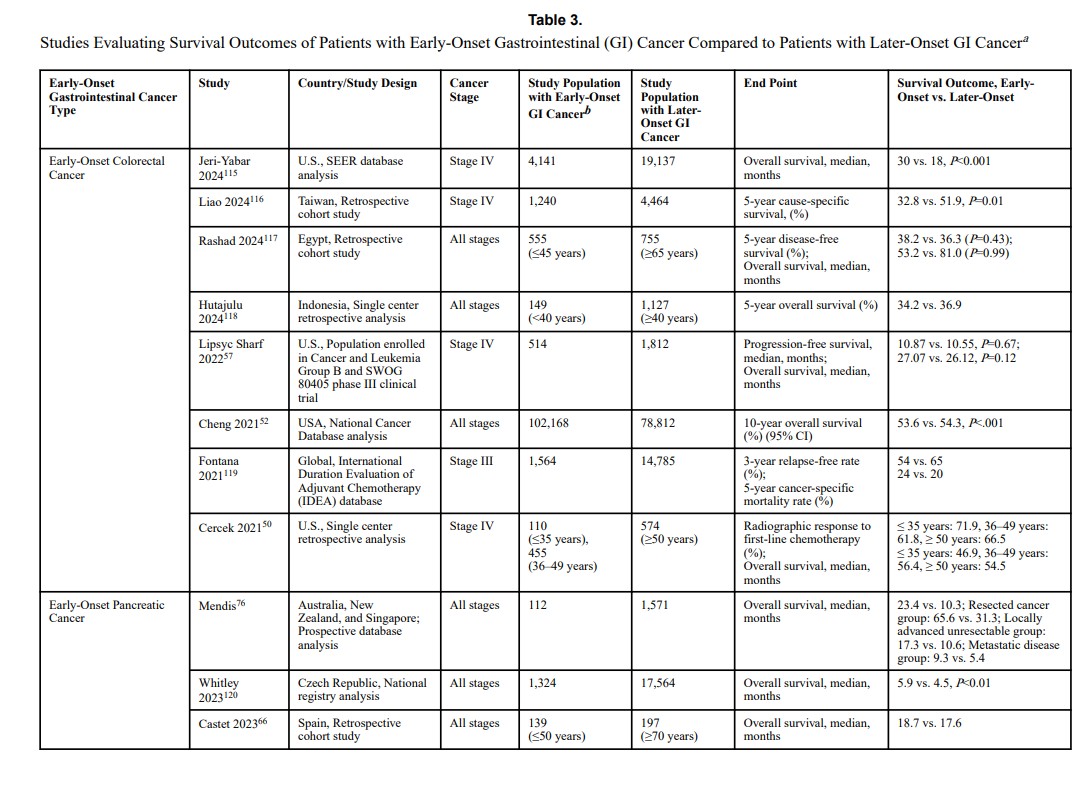
Some studies suggest that patients with eoCRC experience similar or improved cancer-specific survival compared to later-onset CRC, possibly due to more intensive multimodality therapy, while others report no difference or decreased survival (Table 3).52,57,58 Among 15,982 patients diagnosed with stage III CRC, a higher percentage of those with eoCRC received multiagent chemotherapy post-surgery compared with later-onset CRC (86% vs 73%; OR 1.75, 95% CI, 1.58–1.93), with only marginal improvement in adjusted 5-year relative survival (73.7% vs 71.0%, RR 0.89, 95% CI, 0.81–0.97).54 In an RCT of 2,326 patients with metastatic CRC, those with eoCRC did not have improved overall survival (OS) compared with later-onset CRC (median, 27.07 (95% CI, 25.04–30.06) vs. 26.12 (95% CI, 24.94–27.30) months, P=0.12), despite receiving higher chemotherapy dose intensity.57
Early-Onset Pancreatic Cancer (eoPC)
Epidemiology
The incidence of eoPC (defined as age <50 years) increased in the U.S. from 2013 to 2022, (1.1 to 1.4 per 100,000 with AAPC 2.4% (95% CI, 1.7–3.0), P<0.01)6 and globally from 2001 to 2018 (AAPC 2.82–8.75%), most notably among high-income countries.59 In the U.S., there were 1,324 incident cases of eoPC in 2022 (Table 1), representing 5.2% of all PC cases reported in SEER.10,11 From 2013 to 2022, eoPC in the U.S. increased predominantly among women (1.0 to 1.4 per 100,000; AAPC 2.8%, 95% CI, 1.7–3.8) compared with men (1.3 to 1.4 per 100,000; AAPC 1.0%, 95% CI, 0.6–1.5).6 While the AAIR of eoPC was highest among non-Hispanic Black individuals (1.7 per 100,000 in 2022) compared to Hispanic and non-Hispanic White individuals (AAIR 1.4 per 100,000), the largest increases in incidence rates (2013–2022) occurred among Hispanic (AAPC 4.6%, 95% CI, 3.6–5.3) and non-Hispanic White individuals (AAPC 1.6%, 95% CI, 1.1–2.0), compared with non-Hispanic Black individuals (AAPC 1.0%, 95% CI, 0.5–1.6).6 Although pancreatic ductal adenocarcinoma accounts for most PCs (90%), pancreatic neuroendocrine tumors (PNETs) comprise approximately 5%,60 and recent data indicate increasing incidence of early-onset PNETs in the U.S. (AAPC 7.3% women, AAPC 7.5% men, 2001–2020).61
Risk Factors
Risk factors for eoPC include alcohol consumption, smoking, sedentary behavior, obesity, and metabolic dysfunction-associated steatotic liver disease (MASLD) (Table 2). In a study of 5,232 individuals, alcohol consumption of >26 g/day (i.e., 2 drinks/day) vs ≤26 g/day was associated with eoPC (defined as age<60 years, 213 cases among 1,954; OR 1.49, 95% CI, 1.21–1.84), particularly among those <45 years old (25 cases among 226; OR 2.18, 95% CI, 1.17–4.09).62 A prospective study of 167,483 patients reported that multiple risk factors were more strongly associated with eoPC (defined as age≤60 years) than later-onset PC: smoking (98 cases/1,265,695 person-years vs 378/619,032 person-years), obesity (24/201,523 person-years vs 98/146,839 person-years), diabetes (14/41,165 person-years vs 127/124,844), tall height (≥167 cm for women and ≥181 cm for men; 69/833,464 person-years vs 213/357, 342 person-years), and non-O blood group (106/459,562 person-years vs 251/402,869 person-years).63 Presence of 3–5 of these risk factors (vs zero) was associated with HR for PC of 9.24 (95% CI, 4.11–20.77) for age ≤60 years, vs 3.00 (95% CI, 1.85–4.86) for age 61–70 years and 1.46 (95% CI, 1.10–1.94) for age >70 years.63 The HRs for eoPC were 1.85 (95% CI, 1.19–2.88) for obesity, 3.85 (95% CI, 2.07–7.18) for diabetes, and 1.68 (95% CI, 1.21–2.33) for tall height.63 Non-O blood group was more strongly associated with PC risk among participants aged ≤70 years (HR 1.84, 95% CI 1.30–2.61) vs >70 years (HR 1.18, 95% CI 0.97–1.44).63 The mechanism of how non-O blood group64 contributes to PC is unknown, but may involve altered glycosylation (addition of carbohydrates to proteins) resulting in abnormal proteins on pancreatic cells resembling blood group antigens and escape from immune surveillance.65 In a pooled analysis of 1,954 individuals with eoPC (defined as age <60 years) and 3,278 age- and sex-matched controls, those with eoPC were more likely to have a family history of PC in a first-degree relative (diagnosed at any age) compared to control participants (7% vs 2%, OR 2.53, 95% CI, 1.77–3.61).62
Molecular Features
Although most patients with eoPC do not have a hereditary predisposition, approximately 30% have germline variants in DNA damage repair genes such as BRCA1/2 and PALB2, compared to 15% of patients with later-onset PC.66 Other genetic syndromes that confer increased risk for PC include Peutz–Jeghers syndrome (STK11 gene variants), hereditary pancreatitis (mostly PRSS1 gene variants), familial atypical multiple mole melanoma syndrome (CDKN2A gene variants), and Lynch syndrome.67 Compared with later-onset PC, eoPC has a higher prevalence of KRAS wild-type tumors (20% vs <10%) and genetic variants that can be treated with targeted therapies, such as NTRK fusions and IDH1 mutations.66,68–71 eoPCs with high microsatellite instability72 should be identified, as these genetic variants predict response to immunotherapy.73
Screening
Guidelines do not recommend screening for PC among adults considered at average risk.67 However, the American College of Gastroenterology,74 American Gastroenterology Association,67 and the International Cancer of the Pancreas Screening Consortium75 recommend screening of high-risk individuals, including those with inherited genetic syndromes such as BRCA2 or Peutz–Jeghers syndrome, or with a family history of PC in a first-degree relative.67 Screening modalities include abdominal magnetic resonance imaging (MRI) and endoscopic ultrasound, with screening age and intervals determined by the high-risk indication (e.g., starting age of 40 years in CKDN2A mutation carriers, age 35 years for Peutz–Jeghers syndrome).67
Clinical Presentation and Diagnosis
Most patients (85%) with eoPC present with symptoms, including abdominal pain (67%), obstructive jaundice (45%), weight loss (18.8%), gastric outlet obstruction (6.3%), and new-onset diabetes (1.8%).76 Young adults with these symptoms should be evaluated with an abdominal CT scan.71 Young patients with new-onset diabetes or worsening of pre-existing diabetes (prevalent in 14–17%)69,76 who are high-risk for PC should engage in shared decision-making with their clinicians regarding PC work-up or change in surveillance intervals.67,71 Compared to later-onset PC, eoPC is associated with larger tumor size,77 poorly-differentiated histology (19% vs 15%),78 and advanced stage presentation (stage III or IV disease in 62% vs 55%).79
Treatment and Prognosis
Current treatment guidelines do not differ between eoPC and later-onset PC.80 However, in a study of 248,634 patients with PC, more individuals with eoPC received cancer treatment compared to later-onset PC (81% vs 61%), and more often with multimodality therapies (21% vs 15%, adjusted OR 3.89, 95% CI, 3.66–4.15).81 In a retrospective study of 336 patients with PC, 44% with eoPC received intensive chemotherapy (e.g., FOLFIRINOX consisting of 5-FU, irinotecan, and oxaliplatin) vs 15% with later-onset PC.66 Due to a higher frequency of germline DNA damage repair mutations and actionable somatic alterations in eoPC, targeted therapies such as poly (ADP-ribose) polymerase inhibitors may be utilized.66 In the same study, those treated with targeted therapies had significantly longer OS compared to those not receiving targeted therapies (median OS 41.3 vs 16.7 months; HR 0.34, 95% CI, 0.12–0.93) (Table 3).66 Therefore, all patients with eoPC should undergo germline and somatic genetic sequencing to detect hereditary syndromes and identify therapeutic options.66
Early-Onset Esophagogastric Cancer (eoEGC)
Epidemiology
In the U.S., early-onset gastric cancer (eoGC) comprises 10.5% of all GC cases.10,11 From 2013–2022, eoGC incidence increased in both females (AAIR per 100,000, 1.2 to 1.8; AAPC 4.0%, 95% CI, 3.5–4.7) and males (AAIR per 100,000 1.5 to 1.6; AAPC 1.7, 95% CI, 0.3–2.8) (Table 1).6 Early-onset esophageal cancer (eoEC) represents approximately 5.1% of EC cases in the U.S., including 282 cases of adenocarcinoma and 87 cases of squamous cell carcinoma (SCC) in 2022 with AAIR of 0.3 and 0.1 per 100,000, respectively.6 The incidence rates of eoEC increased between 2016–2022 (AAIR per 100,000 of 0.3 to 0.4; APC 1.8%, 95% CI, −0.6 to 6.5).6
Although the global incidence of EGC has declined over the last several decades,82 eoGC increased globally from 2015–2019 (APC 1.39%, 95% CI, 0.06–2.74, P=0.041 in individuals age <40 years).83 The incidence increased in Central Latin America, East Asia, and China from 1990–2019, but decreased in South Korea and Japan, likely due to opportunistic screening (performed per patient preference rather than screening program), Helicobacter pylori eradication, and improved access to healthcare.83 Globally, eoEC accounted for 45,056 incident cases and 39,196 deaths, with corresponding ASRs of 0.05 and 0.04 per 100,000, respectively in 2022.10,11
Risk Factors
Helicobacter pylori is classified as a class I carcinogen (strong evidence of carcinogenicity in humans).84 A cluster-randomized trial of 180,284 individuals in China who were screened for H. pylori reported that H. pylori treatment decreased the incidence of GC (HR 0.86, 95% CI, 0.74–0.99) vs. symptomatic management alone, with crude rates per 1000 person-years of 0.58 and 0.68, respectively. The incidence of GC was further reduced among those who had confirmed H. pylori eradication over 11.8 years of follow-up (HR 0.81, 95% CI, 0.69–0.96) vs. no eradication (HR 1.02, 95% CI, 0.83–1.26); crude rates 0.54 vs 0.78 per 1000 person-years, respectively.85 Other modifiable risk factors for eoGC include consumption of smoked and salted foods such as pickled vegetables and salt-preserved fish and meat (OR 2.1, 95% CI, 1.3–2.8), alcohol use (OR 2.0, 95% CI, 1.3–2.6), and obesity (OR 1.7, 95% CI, 1.5–2.0) (Table 2).86 Non-modifiable risk factors such as family history and hereditary factors are also associated with eoEGC risk, although they do not account for most cases.87
The rising incidence of esophageal adenocarcinoma88 is likely due to increasing obesity rates28 and gastroesophageal reflux disease (GERD),89 both of which may cause Barrett’s esophagus, a strong risk factor for esophageal adenocarcinoma.90,91 In contrast, primary risk factors for esophageal SCC are smoking and heavy alcohol consumption (variably defined as >17 or >35 drinks per week).92,93 Declining trends in smoking have contributed to reduced incidence of esophageal SCC.94
Molecular Features
Patients with eoEGC have a higher prevalence of pathogenic germline alterations compared to later-onset EGC.87 In one study of 466 patients with GC, the prevalence of germline alterations was 20.7% with eoEGC vs 16.1% with later-onset EGC.87 Common hereditary syndromes leading to increased GC risk include include hereditary diffuse GC (CDH1 and rarely CTNNA1 variants), Peutz-Jeghers syndrome, Lynch syndrome, and FAP. Pathogenic germline variants in BRCA2 and PALB2 may also occur.95 eoGC is characterized by fewer somatic tumor mutations (8% vs 23% with later-onset GC), with less microsatellite instability-high tumors (3–6% vs 23%) despite the higher frequency of Lynch syndrome.87,96,97 Somatic alterations in CCNE1 and CDH1 are more common in eoEGC.98
Screening
Screening for GC is not routinely performed in most countries. However, in South Korea, biennial screening with EGD or upper gastrointestinal series begins at age 40 years.99 The American College of Gastroenterology recommends a single screening EGD for individuals with chronic GERD symptoms and ≥3 additional risk factors: male sex, age >50 years, White race, tobacco use, obesity (BMI≥30 kg/m2), and family history of Barrett’s esophagus or EC in a first-degree relative.100 This conditional recommendation is based on low-quality evidence, and efforts are ongoing to refine risk criteria and screening strategies.100 The Taipei Global Consensus also recommends H. pylori screening and eradication in individuals aged 20–40 years in regions with high GC incidence.101
Clinical Presentation and Diagnosis
Most patients are symptomatic at presentation, commonly with pain (54%), weight loss (40%), and swallowing difficulty (29%).98 Patients with new-onset dysphagia, gastrointestinal bleeding (e.g., melena), recurrent aspiration or regurgitation, weight loss, early satiety, and/or anorexia should undergo EGD.102 Barium esophagram103 may be used instead in patients at high risk of perforation with endoscopy, or with limited local access to endoscopy.102 CT scans of the chest, abdomen, and pelvis, upper endoscopic ultrasound, and PET/CT scans should be obtained for staging. If no metastases are detected and surgical resection is considered, diagnostic laparoscopy may be performed along with peritoneal washings to assess for intraperitoneal metastatic disease.104,105 Based on SEER data of 75,225 patients with GC (1973–2015), those with eoGC had more poorly-differentiated tumors (55% vs 47%), signet ring-cell histology (19% vs 10%), diffuse histology (26% vs 15%), and metastatic disease at presentation (50% vs 41%, all P<.01) compared with later-onset GC.96
Treatment and Prognosis
The medical management of eoEGC is similar to later-onset EGC, although young patients with localized GC tend to receive more treatment. In a retrospective cohort study of 738 patients with GC undergoing curative surgery, those with eoGC more frequently received neoadjuvant therapy (63% vs 44%, P<.001) and radical surgery (68% vs 56%, P=.006), though OS was similar (median 50.5 vs 58.9 months; P=0.91) compared to those with later-onset GC (Table 3).106 In a National Cancer Database analysis of 158,599 patients with GC, median OS was 15.34 months (95% CI, 14.95–15.7) for eoGC patients vs 16.39 months (95% CI, 16.16–16.62) for patients ages 50–69 years and 9.99 months (95% CI, 9.82–10.15) for those age ≥70 years (P<.001 across all groups).107 Among 139,210 patients with EC, median OS was 15.24 months (95% CI, 14.72–15.8) for eoEC patients vs 15.34 months (95% CI, 15.15–15.54) for ages 50–69 years and 10.18 months (95% CI, 9.99–10.35) for age ≥70 years (P<.001 across all groups).107
Practical Considerations
Given evidence from RCTs and cohort studies supporting the benefits of CRC screening on incidence and mortality, adherence to screening guidelines is a critical issue.3 In 2022, screening rates were 72.2% among U.S. adults aged 50–75 years,9 and 19.7% for those aged 45–49 years in 2021.108 Among commercially insured U.S. adults aged 45–49 years, CRC screening uptake increased from 0.50% (standard deviation [SD], 0.02%) to 1.51% (SD, 0.59%) between 20 months before and 20 months after the May 2021 USPSTF guideline change (P < .001).109 The various pathways for screening and symptom based diagnosis of eoGI cancers are outlined in Figure 1.
The figure illustrates the diagnostic pathway for early-onset gastrointestinal cancers, from detection to treatment. The figure includes screening-based detection where applicable, and symptom-driven diagnosis, which remains the most common presentation.
a Symptoms and signs that may prompt investigations for diagnosis of early-onset gastrointestinal cancers.
b While some countries, such as Austria and Italy, start screening at 40 years48 and the U.S. at 45 years3, most countries lack guidelines for eoCRC screening in average-risk individuals (individuals without a personal history of CRC, inflammatory bowel disease, hereditary CRC syndromes, other CRC predisposing conditions, or a family history of CRC).3
c Includes individuals at high-risk for developing pancreatic cancer (e.g., inherited genetic syndrome, family history of pancreatic cancer).67,75 Starting age of screening (with abdominal magnetic resonance imaging or endoscopic ultrasound) varies by risk factors (e.g., begin at age 50 years, or 10 years younger than the initial age of familial onset; age 40 years in CKDN2A and PRSS1 mutation carriers with hereditary pancreatitis; age 35 years in the setting of Peutz–Jeghers syndrome)67
d Imaging modality selected based on clinical evaluation at providers discretion.
e New-onset or worsening of pre-existing diabetes may be a sign of pancreatic cancer and warrants appropriate evaluation.67
f Routine EGD screening for eoEGC is not currently performed in most countries, with South Korea being an exception, where biennial screening for gastric cancer with endoscopy or upper gastrointestinal series begins at age 40.99 The American College of Gastroenterology recommends a single screening EGD for individuals with chronic GERD symptoms and at least three of the following additional risk factors for Barrett’s esophagus: male sex, age >50 years, White race, tobacco use, obesity, and family history of Barrett’s esophagus or esophageal adenocarcinoma in a first-degree relative.100 Taipei Global Consensus guidelines endorse mass screening (large-scale screening of whole population groups) and eradication of H. pylori in individuals aged 20–40 years in regions with a high incidence or high risk of gastric cancer.101
In a systematic review of 2,031 patients with eoCRC, 69.6% reported anxiety and 37.8% reported psychosocial distress.110 Concerns about fertility, parenting during cancer and treatment, and financial concerns are also common. Therefore, specialized centers with multidisciplinary teams, including reproductive health specialists, genetic counselors, psychosocial clinicians, and financial counselors, can substantially enhance care. Table 4 summarizes the recommended components and services for specialized centers based on a qualitative study of eoCRC patients and their caregivers at the Young-Onset Colorectal Cancer Center at Dana-Farber Cancer Institute.111
Table 4.
Identified Needs of Patients with Early-Onset Gastrointestinal Cancer and Supportive Resources
Feeling overwhelmed by the health care system and the need for navigation
Dedicated program coordinator for patient navigation
Multidisciplinary evaluation for fertility, parenting concerns, nutrition, sexual health and integrative oncology
Liaison to clinical and research team
Isolation and the need for caregiver and patient peer support
Customized (by disease stage) support groups for patients to establish peer connection and support including one to one programs
Caregiver support group
Curriculum-based learning – regular webinars on relevant topics; Patient and family forum with expert panels, patient representatives, and research presentations.
Life disruption and juggling many different roles and the need for psychosocial support
Comprehensive psychosocial support and financial assistance program
Dedicated social worker in the care team with expertise in young patients, one to one counseling and psychosocial counseling
Virtually accessible platform for services
Enthusiasm about research participation and germline genetic testing
Prospective data collection and biobanks to elucidate underlying biological mechanisms, and facilitate development of novel therapies
Education on research opportunities and germline genetic testing at first oncology appointment with regular check-ins
Availability of clinical trials
Utilize social media platforms to directly engage and partner with patients to accelerate research
a These primary themes highlight the specific needs of young patients with cancer identified in a qualitative study.111
Limitations
This review has several limitations. First, it is not a systematic review, and the quality of included literature was not formally evaluated. Second, some relevant studies may have been missed. Third, this review did not include information about less common eoGI cancers such as early-onset appendix, small bowel, biliary tract, and neuroendocrine cancers, nor eoGI cancers in children and adolescents.
Conclusions
eoGI cancers, typically defined as cancer diagnosed in individuals younger than age 50 years, are among the largest subset of early-onset cancers globally. Treatment is similar to later-onset GI cancers and typically involves a combination of chemotherapy, surgery, and radiation, depending on the cancer type and stage. The prognosis of patients with eoGI cancers is similar to or worse than that of later-onset GI cancers, highlighting the need for improved methods of prevention and early detection.
Commonly Asked Questions.
Which early-onset gastrointestinal cancers are increasing in incidence?
Since 2010, the incidence of early-onset gastrointestinal cancers (diagnosed in individuals younger than age 50 years) has been rising globally, predominantly high-income countries. The highest incidence rates are in colorectal, pancreatic, and esophagastric cancers, but bile duct, gallbladder, appendix, neuroendocrine and small intestine cancers have also been increasing worldwide.
What are risk factors for early-onset gastrointestinal cancers?
There are modifiable and nonmodifiable risk factors that contribute to development of early-onset gastrointestinal cancers. Modifiable risk factors include obesity, low-quality diet (eg, high consumption of processed meats, sugar-sweetened beverages, ultra-processed foods), sedentary lifestyle, cigarette smoking, and alcohol consumption. Non-modifiable risk factors include hereditary cancer syndromes such as Lynch syndrome and inflammatory bowel disease.
How are early-onset gastrointestinal cancers treated?
Treatment of early-onset gastrointestinal cancers is similar to that of later-onset gastrointestinal cancers. However, all patients with early-onset gastrointestinal cancer should undergo germline genetic testing to identify underlying hereditary syndromes and somatic genomic profiling to identify actionable genomic variants (eg, BRCA 1/2 and BRAF V600E mutations). Patients with early-onset gastrointestinal cancer benefit from multidisciplinary care, and should be offered referral for fertility counseling and preservation, and psychosocial support for anxiety, depression, parenting concerns, and financial concerns.
For acknowledgements and references, please see the article.