5.3. Laboratory Measurement (continued)
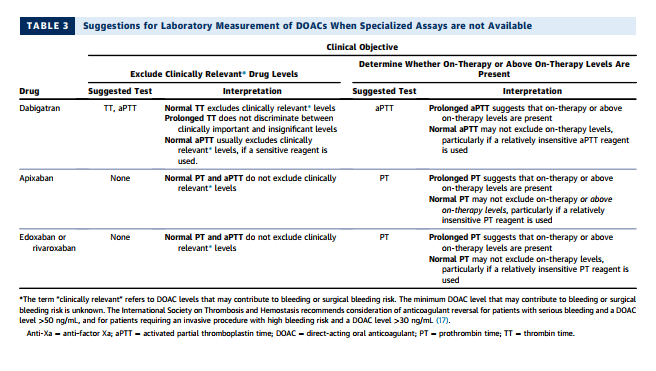
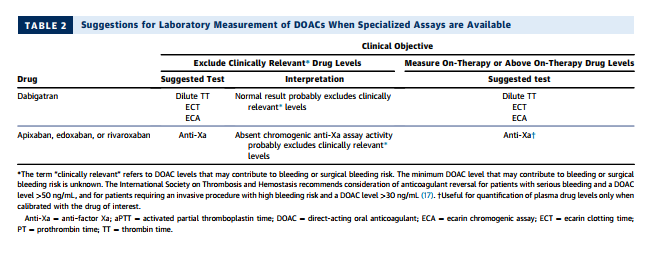
The best tests for assessing the anticoagulant activity of dabigatran include the dilute thrombin time, ecarin clotting time, and ecarin chromogenic assay (see Table 2) (18,19). These tests correlate closely with dabigatran levels measured by the reference standard method, liquid chromatography-tandem mass spectrometry. Unfortunately, these assays are not widely available, particularly on an emergent basis (18,19). In their absence, the thrombin time (TT) and aPTT may be used for qualitative assessment (see Table 3). The TT is exquisitely sensitive to dabigatran, even at very low drug concentrations. Thus, a normal TT excludes clinically relevant dabigatran levels, but a prolonged TT does not discriminate between clinically important and insignificant drug concentrations. All laboratories that do not offer an around-theclock assay for dabigatran quantification should be encouraged to offer the TT for rapid exclusion of clinically significant dabigatran levels. A prolonged aPTT suggests the presence of on-therapy or above on-therapy levels of dabigatran. However, a normal aPTT does not exclude the presence of on-therapy levels, especially when a relatively insensitive aPTT reagent is used (16,18,19)
The preferred test for assessing the anticoagulant activity of apixaban, edoxaban, and rivaroxaban is a chromogenic anti-Xa assay (see Table 2) (18,19). When the assay is calibrated with the drug of interest, the results correlate closely with plasma drug levels measured by liquid chromatography-tandem mass spectrometry. When the assay is calibrated with a low-molecular-weight heparin standard, it can be useful for excluding clinically important levels of drug, but not for quantitation. If an anti-Xa assay is not available, the PT may be useful for qualitative assessment of edoxaban and rivaroxaban. A prolonged PT suggests on-therapy or above on-therapy levels for these agents. However, depending on the sensitivity of the PT reagent, a normal PT may not exclude on-therapy levels (18,19). The PT and aPTT are insensitive to apixaban. A prolonged PT suggests the presence of clinically important apixaban levels, but a normal PT and aPTT do not exclude on-therapy or even above on-therapy levels of the drug (18–20).
Follow Tom On:
Categories
-
Recent Posts
- Linking To And Excerpting From “European Society of Endocrinology clinical practice guideline for evaluation and management of menopause and the perimenopause”
- Linking To And Embedding Dr. Brad Stanfield’s “David Sinclair Says Ozempic Causes Blindness” With Links To Additional Important Resources
- Linking To And Embedding YouTube Video “Pulse Wave Doppler Step by Step – LVOT VTI Example”
- Linking To And Excerpting From Addiction Medicine’s “#536 Q&Apalooza: Your Addiction Questions Answered!”
- Linking To And Embedding Dr. Brad Stanfield’s “Fastest Way to Lose Visceral Fat Without Starving”
- Linking To And Embedding Dr. Brad Stanfield’s “Wrong About Inflammation & Heart Disease (new study)”
- Linking To And Excerpting From Metabolic Mind’s “Exogenous Ketones Explained – Dr. Dom D’Agostino”
- Linking To The YouTube Playlist of The Metabolic Link Podcast
- Linking To And Excerpting From The Alzheimer’s Association’s “Validated clinical assessment instruments”
- Linking To And Excerpting From PedsCases’ “Somatic Symptom and Related Disorders CPS Podcast”
- Linking To And Embedding PedsCases Note’s “Torticollis”
- Linking To And Excerpting From The Cribsiders’ “#141: Cerebral Palsy from Birth to Adolescence – Some CPs (Clinical Pearls) for CP” With Links To Additional Resources
- Linking To And Excerpting From The New York Times Article “3 small habits mental performance coaches think could have the biggest impact”
- Linking To And Excerpting From The Cribsiders’ “#14: Infant Nutrition: Digestible Pearls with Dr. Joan Meek, MD”
- Linking To And Embedding Metabolic Mind’s “Keto 101: Everything You Need to Know About Ketone Testing”
- Linking To And Embedding The U.S. Preventive Services Taskforce’s “Final Recommendation Statement Lung Cancer: Screening”
- Linking To And Embedding ACCP Chest’s “Refractory Chronic Cough: A Primary Care Primer” With Links To Additional Resources
- Linking To And Excerpting From ACCP CHEST’s “Refractory Chronic Cough: Disease Overview and Current Management for Pulmonology Specialists” With Links To Additional Resources
- Linking To And Embedding ACCP Chest’s “Cardiopulmonary Exercise Testing: Basics and Case-Based Learning”
- Linking To And Excerpting From The Cribsiders’ “#76: IV Fluids – Salty and Sweet”
- Linking To And Excerpting From The Cribsiders’ “#33: Febrile Infants – When Babies Are Too Hot”
- Linking To And Excerpting From CDC’s “Rabies Post-exposure Prophylaxis Guidance”
- Linking To And Excerpting From The Cribsiders’ “#2:Go with the High Flow: Bronchiolitis with Dr. Brian Alverson”
- Linking To And Excerpting From The Cribsiders’ “#131: New Kids on the Block: Special Care Nursery”
- Linking To And Embedding Critical Care Time’s “REBOOT ARDS: Unpacking Acute Respiratory Distress Syndrome from Pathophysiology to Treatment”
- Linking To And Excerpting From Critical Care Time’s “82. Strokes and Intro to Neurocritical Care with Dr Casey Albin”
- Linking To And Excerpting From StatPearls’ “Postmenopausal Bleeding”
- Linking To And Excerpting From Dr. Boz’s “95% of you are doing keto wrong. Here’s how to do it right”
- Linking To And Embedding Dr. Boz’s “I won’t tell you what to eat… except THIS” Part 2 With The Transcript And Slides
- Linking To And Excerpting From ACOG’s “Screening For Cervical Cancer”